Showing posts with label gastropods. Show all posts

Little Pied Cormorant, Cat's Eye Sea Shell

0 comments
We went walking around the tide pools the other day. Saw a Little Pied Cormorant:

The Little Pied Cormorant is entirely black above and white below. The face is dusky and, in adult birds, the white of the underside extends to above the eye. Immature birds resemble the adults except there is no white above the eye.


You can tell them from the Pied cormorant…

The Little Pied Cormorant resembles the Pied Cormorant, Phalacrocorax varius, but is easily distinguished by its smaller size and proportionately shorter bill The Pied Cormorant also has an orange-yellow face patch and black thighs.

A little closer:
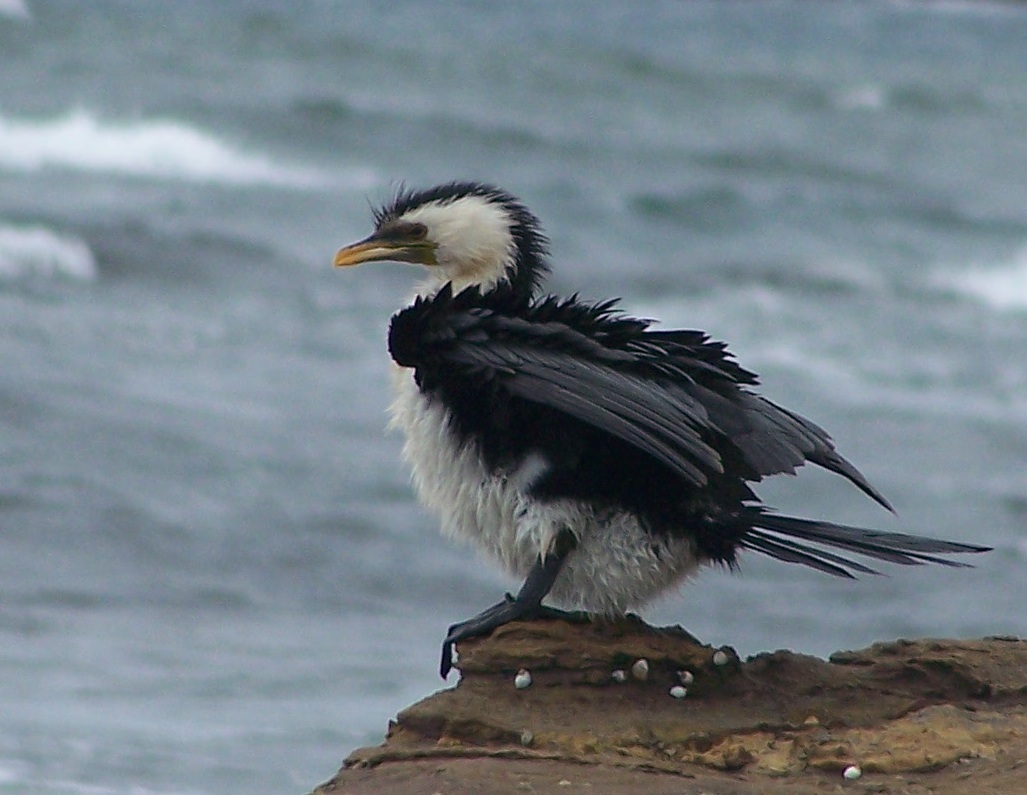

He took off shortly after posing for us and went diving for fish.

Christine went for a stroll to show off her lustrous shoulders:


She beckons to me:


She has found something:


It's a Cat's Eye shell (not Tiger's Eye, as is mentioned). We left it there in its little pool, because we thought it was a living snail. When we got home we found out it's actually an operculum, or "doorway," of a snail:

The operculum is attached to the upper surface of the foot and in its most complete state, it serves as a sort of "trapdoor" to close the aperture of the shell when the soft parts of the animal are retracted.
Ones like this are usually, my research says, from the Turbo genus of sea snails.

We went back to the pools to get it. Luckily it was still there.

It's a little hard to see, but it has some beautiful, subtle coloring. (Click on photo to em-biggen.)

Sea Hare

0 comments
The tide pools at Collaroy are really something. Christine made a remarkable find yesterday (more later, on the Cat's Eye), and not long ago we got photos and video of strange snaillike creature:


I think it might be a sea hare, a type of sea slug:

Sea hares have large flaps covering their backs and gills. They also have large 'ears' for which they are called 'hares'. They also have large mouth flaps with which they can explore a wide swath for edible weeds. Being so vulnerable without a large protective shell, they are nonetheless not predated upon, presumably because they taste foul. All sea hares are voracious grazers and prolific spawners. Like octopus, sea hares can squirt ink when frightened. All sea hares carry a remnant of a shell under their folds. By opening the folds gently while sliding one's finger over its skin, one can feel the thin shell. If the sea hare co-operates, it can even be seen.
I'm not sure if it's a sea hare, the colors and body shapes seem to vary greatly, but you can really sea the "ears" in the  photos, and what appears to be flaps on its back.

Here's some video of one munching on some algae:

 
Copyright © littleaustralia-Cinema-Blend Blogger Theme by BloggerThemes & newwpthemes Sponsored by Internet Entrepreneur