Don't quite know how this happens, but these guys are simply unafraid of people. It's probably something that's been passed down through many generations—evidenced by the fact that these four are made up of a mating pair and their two young (they ocassionally feed them via their crops still), who they have already taught that humans like us are suckers.
Full video, with exciting (not exciting) pixellation interruptions for first minute-and-a-half:
Rainbow lorikeets (Trichoglossus haematodus) information at Birds In Backyards.
Showing posts with label Animals. Show all posts
Showing posts with label Animals. Show all posts
Two Blind Indus River Dolphins Found Dead
Labels:
Animals,
cetaceans
0
comments

Tragic:
Two more blind dolphins were found dead in the Indus River here on Saturday, putting the number of dead dolphins found in Sukkur to 28 in six months.
The Wildlife Department shifted the two dead blind dolphins to Dolphin Research Institute for post- mortem.
The wildlife and the fisheries departments have so far failed to find the possible cause of the deaths of the precious specie. Sources said that the higher authorities recently formed a probe committee, which had revealed that some fisherman threw poisonous substance into the river which is causing deaths of the endangered fish found only in two rivers Asia-Ganges and the Indus River.
I've seen those dolphins, or a closely related species, in the Ganges River. Just magical creatures, so elusive—I could only ever see them for a second as they curved up out of the water and down again quickly. Nobody else was seeing them—I thought I was seeing things. The imprint off their shape—especially the very long beak—seemed to be burned into my cornea.
Let's hope they figure out what the hell's going on.
Let's hope they figure out what the hell's going on.

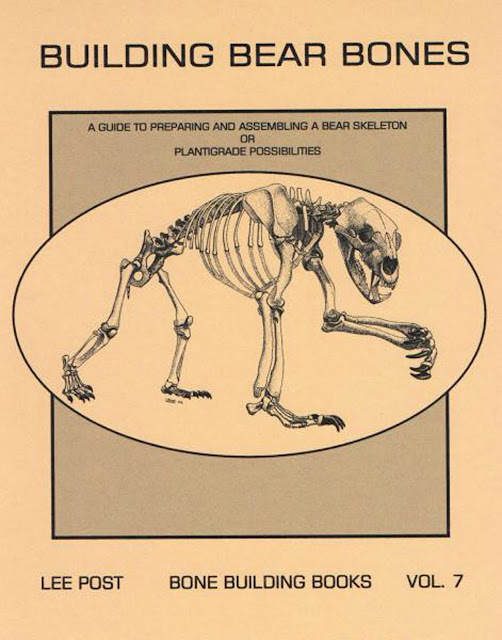
"A Guide to Preparing and Assembling a Bear Skeleton"
Labels:
Animals,
books,
mammals
0
comments
I'm researching an article about bears—did you know that fossil evidence shows that polar bears diverged from brown bears starting only about 200,000 years ago? amazing!—and I just came across this:
Here's a sample page:

I think we all know that we need this book. It's only $34.99—and you never know how a party might end up some night, for example.
Not a lot of people are going to be articulating bear skeletons, but if you were—this is the manual you would want. Bear skeletons are fascinating because the anatomy of a standing bear is so similar to our own. The skinned-out hands and feet are sometimes turned in as homicide remains. This manual has detailed illustrations of bear bones, including all the carpals, and tarsals from the hands and feet. This is the step by step process once used by a grade school to do a museum quality skeletal mount of a bear.

Here's a sample page:

I think we all know that we need this book. It's only $34.99—and you never know how a party might end up some night, for example.
Morning Bird Calls [updated]
Labels:
Animals,
birds,
magpies
0
comments
It's 6 a.m. Since about 5 this bird has been serenading me:
I wish I knew what it was. I think it's a currawong, but I'm not sure.
If you listen very closely after the string of bigger, more obvious notes, there is sometimes (I think twice, here) a very tiny, two-note trill, very high. Just beautiful.
Update: It's a magpie!Thank you to the commenter below!
I wish I knew what it was. I think it's a currawong, but I'm not sure.
If you listen very closely after the string of bigger, more obvious notes, there is sometimes (I think twice, here) a very tiny, two-note trill, very high. Just beautiful.
Update: It's a magpie!Thank you to the commenter below!
White-Faced Heron, Tide Pools [updated]
Labels:
Animals,
australia,
birds,
marine life
0
comments
A few shots from local beaches.
This beautiful bird was walking around down by the collaroy tide pools. It was about three feet tall, and it's a White-faced Heron:


An interesting fact about these birds:
"Nuptial plumes." Sexy.
Here's a bit of Eastern Rock Lobster (mentioned previously here):


A beautiful snail of some sort. Alive. (Update: Old friend Sara in the UK informs me that this is a cowry. Probably this one. It is a type of sea snail, but, as you can see, it has a uniquely shaped shell. Thank you, Sara!):

Same snail, underside:

This just to make my golfing friends jealous. The golf course about a twenty minute walk from home:

Some kind of tide pool creatures' homes washed up on the beach:

Weird, gelatinous creatures in a tide pool crevice:

One of the above creatures out of crevice:

Evidence of ancient beach civilization:

The lovely rocks of the upper tide pool area:

This beautiful bird was walking around down by the collaroy tide pools. It was about three feet tall, and it's a White-faced Heron:


An interesting fact about these birds:
When breeding, the birds have long feathers (nuptial plumes) on the head, neck and back.
"Nuptial plumes." Sexy.
Here's a bit of Eastern Rock Lobster (mentioned previously here):


A beautiful snail of some sort. Alive. (Update: Old friend Sara in the UK informs me that this is a cowry. Probably this one. It is a type of sea snail, but, as you can see, it has a uniquely shaped shell. Thank you, Sara!):

Same snail, underside:

This just to make my golfing friends jealous. The golf course about a twenty minute walk from home:

Some kind of tide pool creatures' homes washed up on the beach:

Weird, gelatinous creatures in a tide pool crevice:

One of the above creatures out of crevice:

Evidence of ancient beach civilization:

The lovely rocks of the upper tide pool area:

Cougar Sightings
Labels:
Animals,
U.S.
0
comments
Something you will never see in the news in Australia: Cougar sightings up in Ashland, Oregon, my old home:
I saw a cougar just once in my twenty years in Ashland, leaping two lanes and shoulders of the highway in front of the car in front of me on I-5 just north of the Ashland St. exit. Beautiful sight.
More cougar sightings in Ashland parks have been reported to the city's Parks and Recreation department.
The Parks Department received two reports of cougar sightings on Wednesday, just weeks after a man reported seeing a cougar feeding on a deer carcass in Lithia Park on May 20.
I saw a cougar just once in my twenty years in Ashland, leaping two lanes and shoulders of the highway in front of the car in front of me on I-5 just north of the Ashland St. exit. Beautiful sight.
Good Tasmanian Devil News
Labels:
Animals,
marsupials
0
comments
I've blogged about the Tasmanian Devil face cancer epidemic—it's communicable!—before. Well, today, some good news:
Efforts to save the Tasmanian Devil have received a boost, with the first joeys arriving in an insurance population of the species at a Hunter Valley property.
A year ago 50 devils were released in a free-range enclosure at a property owned by media mogul James Packer, as part of a plan to produce a thousand disease-free devils by 2021.
The Devil Ark program is run by the Australian Reptile Park and spokeswoman Liz Vella says the ambitious plan is paying off.
"We have got several mums with babies," she said.
Much more info at TassieDevil..com
Lizard
Took this photo in 2006. East of Canberra got out of the car for some reason or other, saw this little guy not far from the road digging a little hole. I don't know what type of lizard he is. I'll try and find out.
Look at the back legs on that sucker.

Look at the back legs on that sucker.
Crab
Labels:
Animals,
australia,
marine life,
photos,
travel
0
comments
Crab in a pool of shells, Pebbly Beach, South Coast, NSW:


Surf Fishing: Flathead and Mystery Crab
Labels:
Animals,
australia
0
comments
I went fishing yesterday. (Was it a Good Friday thing? Some smoke from a stirred childhood memory?) Christine came along, and spent some time trying to catch beach worms.

Now here's the weird thing: The flathead you catch surf fishing around here, the way I understand it, is the dusky flathead. But the dusky flathead, like all flathead species, I'm learning, has a characteristic tail:
Look at this fish's tail. Click on the pic and then again to zoom in.

You see those spots on the tail? I'm pretty sure that tells us this is a Northern flathead:
Here's an image of a tail.
I quickly got out my book and found that flathead have to be 33 centimeters, about 13 inches—to keep. This one was a few centimeters short, so back into the Pacific he went.
Christine gave up on the beach worms—they're so hard to catch—and went home. About an hour later I felt something tugging on my bait. I yanked the rod, and got something. It felt like a bigger fish that the first. I pulled it in and in the surf saw...what?...the hell is that...damn, it's a crab. He fell off right at the edge of the surf. I don't think I had hooked him—I think he just held on to that piece of pilchard for the whole ride to the beach.

I have no idea what kind off crab that is. My NSW fishing book lists just three that have size limits; this crab isn't one of those (mud crab maybe); for the rest there is no size limit.

Grrrr.

I put him back anyway. Can't cook up one little crab. He scampered and swam sideways back into the surf.
Just a few minutes in I caught a flathead on a little prawn (not fresh; been in the freezer for ages). Clean, hard strike, I didn't have to set the hook, it just took it and ran. Christine took a shot of the hook removal:

Now here's the weird thing: The flathead you catch surf fishing around here, the way I understand it, is the dusky flathead. But the dusky flathead, like all flathead species, I'm learning, has a characteristic tail:
Dusky Flathead are easily distinguished from other flathead by the distinctive black spot circled in blue on their tail fin.
Look at this fish's tail. Click on the pic and then again to zoom in.

You see those spots on the tail? I'm pretty sure that tells us this is a Northern flathead:
The Northern Flathead has a pale brown body speckled with pinkish-red spots. The caudal fin (tail) is the best way to identify the northern sand flathead, with a pattern of almost horizontal flag-like black stripes across the tail (three distinct black bars on the upper portion and two on the lower portion of the caudal fin).
Here's an image of a tail.
I quickly got out my book and found that flathead have to be 33 centimeters, about 13 inches—to keep. This one was a few centimeters short, so back into the Pacific he went.
Christine gave up on the beach worms—they're so hard to catch—and went home. About an hour later I felt something tugging on my bait. I yanked the rod, and got something. It felt like a bigger fish that the first. I pulled it in and in the surf saw...what?...the hell is that...damn, it's a crab. He fell off right at the edge of the surf. I don't think I had hooked him—I think he just held on to that piece of pilchard for the whole ride to the beach.


Grrrr.

I put him back anyway. Can't cook up one little crab. He scampered and swam sideways back into the surf.
Eels, Leeches, And a Giant Spider on My Face [updtd]
Labels:
Animals,
birds,
fish,
marsupials,
parks
0
comments
So you're in Australia. In the southeastern state of New South Wales, the North Carolina of Australia. In Sydney. (Let's call it Wilmington). Go straight north from the city center about 20 miles, er, about 32 kilometers, and you run into Ku-ring-gai Chase National Park.
Now you all know where to search for my body.
Right. To the latest excursion.
I entered the park at the Ku-ring-gai Wildflower Garden, and soon heard a "knocking on a hollow wood box" bird-call I am completely unfamiliar with. Five-second video:
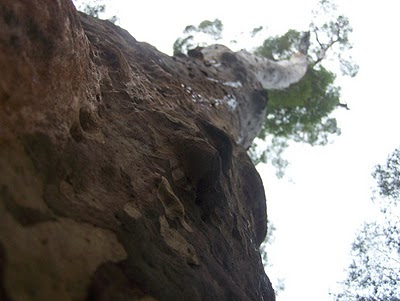
I unfortunately do not know the type of this gum (eucaplyptus) tree, but it is a big, beautiful, splotchy specimen:

So I'm taking a big step down from one rock to another when I go full face into a thick spider web. Hooray for me. I get as much web off my face and out of my hair as possible, hoping that no giant spider was on my head, and amble on. About a minute later I feel something walking on my left cheek. It was, of course, a giant spider.

This is Nephila edulis, the Gold Orb Weaver. Not much power in their venom—localized pain and swelling is all—but they're big. I unfortunately seem to have dislodged a leg or two from her. (Yes, her: the males are much smaller.) Sorry about that, spider.
Now here's a very cool thing I just learned via this hike. I got a few shots of a big brown bird that seemed very curious about me. Almost looked hawkish [update, April 18, 2011: Christine found a hawkish story!], but also kind off dovish.

A little closer:

I had no idea what it was, but this fantastic website, Birds in Backyards, has a Bird Finder: You enter in relative size, color, body type, and tail type, and it will suggest a possible bird. I did just that with this bird—and found my bird: a Brown Cuckoo Dove. No question about it. Here are some more pics. And here's its backside, just because:

If anyone can give me a clue as to what kind of flower this is, it'd be greatly appreciated. Christine guessed oleander, but that's not quite right. Related maybe?

I came to Cowan Creek, and saw some strange animal tracks. I have no idea what they are - but I just found a photo on Flickr of what some dude says is swamp wallaby tracks. They're just like my tracks here!
I saw a wallaby, a swamp wallaby, I'm sure, as they're the only ones in these parts, as far as my reading tells me. It was a beautiful dark chocolate brown, and its back appeared out of a large ferny area as it hopped away from me. No pic, alas: I chased it, of course, but wallabies are a bit faster than humans.
I did get a pic of an eel, or, like the cobbler catfish, an eel-like fish. Huge, maybe three feet long.

Video of another, smaller one:
I think they're Long-finned Eels. Fascinating!
More here.
While filming that first eel, I had the holy crap scared out of me by a huge, fat owl, or owl-like bird, that flew out of a tree just above the creek and made a getaway. The camera, flying violently around, as it often just does, unfortunately did not capture anything but the sound of its esccape.
I looked down at my feet at one point, and saw blood. Leeches. Again.
Then, whilst picking leeches from by bloody feet, a tiny bird came to visit, just a few feet away. Once again I fed some info into the Birds in Backyards bird finder tool, and, I found the Yellow Breasted Robin.
She's a beauty, isn't she?

Now you all know where to search for my body.
Right. To the latest excursion.
I entered the park at the Ku-ring-gai Wildflower Garden, and soon heard a "knocking on a hollow wood box" bird-call I am completely unfamiliar with. Five-second video:
I unfortunately do not know the type of this gum (eucaplyptus) tree, but it is a big, beautiful, splotchy specimen:


So I'm taking a big step down from one rock to another when I go full face into a thick spider web. Hooray for me. I get as much web off my face and out of my hair as possible, hoping that no giant spider was on my head, and amble on. About a minute later I feel something walking on my left cheek. It was, of course, a giant spider.

This is Nephila edulis, the Gold Orb Weaver. Not much power in their venom—localized pain and swelling is all—but they're big. I unfortunately seem to have dislodged a leg or two from her. (Yes, her: the males are much smaller.) Sorry about that, spider.
Now here's a very cool thing I just learned via this hike. I got a few shots of a big brown bird that seemed very curious about me. Almost looked hawkish [update, April 18, 2011: Christine found a hawkish story!], but also kind off dovish.

A little closer:

I had no idea what it was, but this fantastic website, Birds in Backyards, has a Bird Finder: You enter in relative size, color, body type, and tail type, and it will suggest a possible bird. I did just that with this bird—and found my bird: a Brown Cuckoo Dove. No question about it. Here are some more pics. And here's its backside, just because:

If anyone can give me a clue as to what kind of flower this is, it'd be greatly appreciated. Christine guessed oleander, but that's not quite right. Related maybe?

I came to Cowan Creek, and saw some strange animal tracks. I have no idea what they are - but I just found a photo on Flickr of what some dude says is swamp wallaby tracks. They're just like my tracks here!
I saw a wallaby, a swamp wallaby, I'm sure, as they're the only ones in these parts, as far as my reading tells me. It was a beautiful dark chocolate brown, and its back appeared out of a large ferny area as it hopped away from me. No pic, alas: I chased it, of course, but wallabies are a bit faster than humans.
I did get a pic of an eel, or, like the cobbler catfish, an eel-like fish. Huge, maybe three feet long.

Video of another, smaller one:
I think they're Long-finned Eels. Fascinating!
The larvae of Long-finned eels (glass eels, ~58 mm length) enter estuaries and migrate upstream to freshwater habitats where they may remain for up to 52 years before returning to the ocean to spawn and die.
More here.
While filming that first eel, I had the holy crap scared out of me by a huge, fat owl, or owl-like bird, that flew out of a tree just above the creek and made a getaway. The camera, flying violently around, as it often just does, unfortunately did not capture anything but the sound of its esccape.
I looked down at my feet at one point, and saw blood. Leeches. Again.
Then, whilst picking leeches from by bloody feet, a tiny bird came to visit, just a few feet away. Once again I fed some info into the Birds in Backyards bird finder tool, and, I found the Yellow Breasted Robin.
She's a beauty, isn't she?

Just Make Them Die
Labels:
Animals
0
comments
Jesus. Here's a link to a YouTube video. I watched about 3 seconds and I want to kill people. This is horrible.
Laughing Kookaburra
Labels:
Animals,
australia,
birds
0
comments

Also from my 2006 trip, this is a Laughing Kookaburra, one of four kookaburra species, and the only one in the Sydney region.
Kookaburras are related to the little fellow I posted just below: They're members of kingfisher family, but while the one featured below is a river kingfisher, the kookaburra is a tree kingfisher. They're carnivores, too, but rather than fish they eat insects, worms, crustaceans, reptiles, frogs, snakes, mice, and even chicks of other birds.
They are most famous for their call, which begins at our place right around 4:15 every morning:
According to an Aboriginal legend, the kookaburra's famous chorus of laughter every morning is a signal for the sky people to light the great fire that illuminates and warms the earth by day. The legend captures the imagination, but the true function of the familiar cacophony is to advertise the territory of this bold bird. The Laughing Kookaburra is the largest of the kingfisher family, but unlike most of its relatives, it is sedentary and occupies the same territories the year round.This site says that early European settlers described the call "appalling as the ravings of a madman . . . and ends in a prolonged sardonic chuckle."
Here's an example, but without the characteristic "hoo hoo hoo" start. This is just a raspy call.
The same site says this:
The name kookaburra is derived from an Aboriginal name, similar to the onomatopoeic words from other Aboriginal languages, including akkaburra, googooburra, gurgara, gingara and arkooburra.More:
Laughing Kookaburras are believed to pair for life. The nest is a bare chamber in a naturally occurring tree hollow or in a burrow excavated in an arboreal (tree-dwelling) termite mound. Both sexes share the incubation duties and both care for the young. Other Laughing Kookaburras, usually offspring of the previous one to two years, act as 'helpers' during the breeding season. Every bird in the group shares all parenting duties.I actually saw one emerge from a termite nest on a tree once. Thought it was a little cream-colored rodent at first, then off it flew. Here's a photo of a termite mound on a tree with holes that were likely once entrances to a kookaburra nest:

The Laughing Kookaburra.

My First Blue Bottle Jellyfish Sting
Labels:
Animals,
australia,
marine life
0
comments
So I was trying to catch beach worms the other day - more on that later - when Christine noticed the delicate tentacles of a dreaded blue bottle jellyfish around my legs.
I took photos of blue bottles for this post. One, with one long tentacle displayed:

I must have gotten a baby, or something, because it was just a mild, annoying sting—although it did last for a couple hours. Here are the marks left on my ankle:

But let's look further into the blue bottle jellyfish—which isn't a jellyfish. And it's not one animal. A blue bottle is four different kinds of creatures, known as zooids, living together to form what seems to be one creature. One kind makes up the flotation bladder, another does the hunting, another still the eating and digesting, and yet another takes care of reproduction. (Why do I always have to do the digesting and Francis always gets reproduction? It's NOT. FAIR!) I'm not kidding:
Bluebottle tentacles will cause a sharp, painful sting if they are touched, which is aggravated by rubbing the area. Intense pain may be felt from a few minutes to many hours and develops into a dull ache which then spreads to surrounding joints. The affected area develops a red line with small white lesions. In severe cases blisters and weals looking like a string of beads may appear. Victims may exhibit signs of shock. Children, asthmatics and people with allergies can be badly affected and many cases of respiratory distress have been reported in Australia.
I took photos of blue bottles for this post. One, with one long tentacle displayed:

I must have gotten a baby, or something, because it was just a mild, annoying sting—although it did last for a couple hours. Here are the marks left on my ankle:

But let's look further into the blue bottle jellyfish—which isn't a jellyfish. And it's not one animal. A blue bottle is four different kinds of creatures, known as zooids, living together to form what seems to be one creature. One kind makes up the flotation bladder, another does the hunting, another still the eating and digesting, and yet another takes care of reproduction. (Why do I always have to do the digesting and Francis always gets reproduction? It's NOT. FAIR!) I'm not kidding:
The Bluebottle or Portuguese Man-of-War is not a single animal but a colony of four kinds of highly modified individuals (polyps). The polyps are dependent on one another for survival.I'll be doing more on these fascinating creatures in the future, and on zooids in general, in the future.
The float (pneumatophore) is a single individual and supports the rest of the colony. The tentacles (dactylozooids) are polyps concerned with the detection and capture of food and convey their prey to the digestive polyps (gastrozooids). Reproduction is carried out by the gonozooids, another type of polyp.
My First Aussie Fish Catch
Labels:
Animals,
fish
0
comments
I went fishing last night, at dusk, and then into the dark, in a light rain. You just don't know how good it is to stand in the surf up to your ankles or nipples for a few hours, especially while doing something like fishing, which has its own kinds of goodness.
Anyway, I caught my first fish. Even in the dark I could tell it was a flathead, which is supposedly a great eating fish. Mine was unfortunately a small one, about 8 inches (they need to be 26 centimeters, which is like 8 feet I think). Unfortunately again the combination of it being dark and the fact that the little bugger nearly swallowed the hook made it impossible to get the hook free without messing the fish up pretty bad. I was trying and trying and the spines on the fish's gills kept stabbing me in the hands and I'm cussing up a storm in the rain trying to get the goddamn hook out. Blech. Made me feel like shit. I finally got it and put the guy back in the ocean. He swam off.
I hope the little fella lived and grows to a really good size and gets caught on my hook one day so I can eat him.
Anyway, I caught my first fish. Even in the dark I could tell it was a flathead, which is supposedly a great eating fish. Mine was unfortunately a small one, about 8 inches (they need to be 26 centimeters, which is like 8 feet I think). Unfortunately again the combination of it being dark and the fact that the little bugger nearly swallowed the hook made it impossible to get the hook free without messing the fish up pretty bad. I was trying and trying and the spines on the fish's gills kept stabbing me in the hands and I'm cussing up a storm in the rain trying to get the goddamn hook out. Blech. Made me feel like shit. I finally got it and put the guy back in the ocean. He swam off.
I hope the little fella lived and grows to a really good size and gets caught on my hook one day so I can eat him.
"It's Blue Murder"
Labels:
Animals,
various poisonous things
0
comments
Riding off the blue bottle post from the other day, here's the front page of the ever-subtle Manly Daily today:

2,000 treated for stings. Now if only they had listened to Christine…

2,000 treated for stings. Now if only they had listened to Christine…
Signs You're in Australia [updated]
Labels:
Animals,
australia,
culture,
venomous things
0
comments
I mean that literally. (Click to enlarge signs and the lovely and vivacious Tin.)

The sign to the right says "Caution - Blue Bottles." That would be the blue bottle jellyfish:

Update: In response to Sara on Facebook, who wrote:
Well you know, Sara, we've discussed just that. Christine has extensive history with blue bottles, and has long talked about how they used to put vinegar on the wounds left by them. Or peed on them if you didn't happen to bring your vinegar along to the beach. But that is done no more, according to our inquiries. Today they recommend washing thoroughly, then applying ice - which will lead to the pain lasting only some hours.
Basically, they don't know jack all what to do, and they just keep coming up with different things every decade or so.
Here's another good closeup, showing the blue bottle's "crimped" edge, giving it what Christine said was a "samosa" look:

After they've been beach-bound for some time, they shrink to a still beautiful "bottle cap" (my definition) stage:


The sign to the right says "Caution - Blue Bottles." That would be the blue bottle jellyfish:
They came in the two nights ago. There are thousands and thousands washed up on shore. Here's just one, with one of it's very long tentacles:
If a tentacle attaches itself to a human, it releases a poison (through the use of nematocysts), and if you continue to rub the skin after the tentacle has been removed more poison or venom will be released. If you are stung, it is best to wash the area without touching. A cold pack should be used to relieve the pain. If stung, please consult a doctor immediately. No fatalities have ever been reported within Australia or New Zealand from the sting of a blue bottle.

Update: In response to Sara on Facebook, who wrote:
Apparently the quickest and most effective relief from the pain is to pee on the affected area, unless you have a bottle of vinegar handy.
Well you know, Sara, we've discussed just that. Christine has extensive history with blue bottles, and has long talked about how they used to put vinegar on the wounds left by them. Or peed on them if you didn't happen to bring your vinegar along to the beach. But that is done no more, according to our inquiries. Today they recommend washing thoroughly, then applying ice - which will lead to the pain lasting only some hours.
Basically, they don't know jack all what to do, and they just keep coming up with different things every decade or so.
Here's another good closeup, showing the blue bottle's "crimped" edge, giving it what Christine said was a "samosa" look:

After they've been beach-bound for some time, they shrink to a still beautiful "bottle cap" (my definition) stage:

Kur-ring-gai Chase
I spent several hours yesterday walking in Ku-ring-gai Chase National Park just north of Sydney. (The name is actually redundant: a chase is "a tract of unenclosed land used as a game preserve." The founders of the chase didn't want to call it a park, as that, in their 1890s view of things, suggested a fenced in area.)
It was hot, in the 90s, dry, I didn't have enough water, and my hip started hurting before I got out of bed. I went off-trail at one point in chase of a brown furry animal the size of a small dog, through thick bush in an area home to death adders and brown snakes, both of which can kill you quickly. It was all around glorious, and I found some spectacular spots in a park I will be walking regularly.
As soon as I got off the bus I saw a strange little bird, a youngun, intent on digging a little pit, and completely unafraid of me. I don't know what it is, perhaps a young bush turkey:
I saw a fat goanna, at least three feet long—look how long that tail is—which made the heat and the hurt totally worthwhile:

Here's a good head shot:

And one of my famously shaky videos, at the end of which you can see a bit of the goanna shuffle:
After stumbling down the hill to try and get a shot of the mysterious creature, a reddish, chocolate brown thing with thick fur, I came upon McCarrs Creek, where I caught a tiny crab:
Back on McCarrs Creek road I waited for a bus, and saw a dead animal. I think it was a swamp wallaby. You can see the long feet, and tail, and the little arms:


Poor critter. That's probably what I saw in the bush. Hopefully next time I'll have a good photo of a live one.
It was hot, in the 90s, dry, I didn't have enough water, and my hip started hurting before I got out of bed. I went off-trail at one point in chase of a brown furry animal the size of a small dog, through thick bush in an area home to death adders and brown snakes, both of which can kill you quickly. It was all around glorious, and I found some spectacular spots in a park I will be walking regularly.
As soon as I got off the bus I saw a strange little bird, a youngun, intent on digging a little pit, and completely unafraid of me. I don't know what it is, perhaps a young bush turkey:
I saw a fat goanna, at least three feet long—look how long that tail is—which made the heat and the hurt totally worthwhile:

Here's a good head shot:

And one of my famously shaky videos, at the end of which you can see a bit of the goanna shuffle:
After stumbling down the hill to try and get a shot of the mysterious creature, a reddish, chocolate brown thing with thick fur, I came upon McCarrs Creek, where I caught a tiny crab:
Back on McCarrs Creek road I waited for a bus, and saw a dead animal. I think it was a swamp wallaby. You can see the long feet, and tail, and the little arms:


Poor critter. That's probably what I saw in the bush. Hopefully next time I'll have a good photo of a live one.
Subscribe to:
Posts (Atom)