Don't quite know how this happens, but these guys are simply unafraid of people. It's probably something that's been passed down through many generations—evidenced by the fact that these four are made up of a mating pair and their two young (they ocassionally feed them via their crops still), who they have already taught that humans like us are suckers.
Full video, with exciting (not exciting) pixellation interruptions for first minute-and-a-half:
Rainbow lorikeets (Trichoglossus haematodus) information at Birds In Backyards.
Showing posts with label birds. Show all posts
Showing posts with label birds. Show all posts
Carnivorous Butcherbird on Veranda
Labels:
australia,
birds,
collaroy
0
comments
This little guy has been visiting nearly every day for some weeks now.

It's a relative of the magpie.
Rear view:

The other day, alongside a visiting lorikeet:

It's a Grey butcherbird:
Like the magpies, butcherbirds are carnivores:
Good shots of the hook on its beak, and great audio of it's beautiful song, here.
Updated: This post has been edited - as I mistakenly said butcherbirds were related to the kingfishers. They are not! I am very sorry!

It's a relative of the magpie.
Rear view:

The other day, alongside a visiting lorikeet:

It's a Grey butcherbird:
The adult Grey Butcherbird has a black crown and face and a grey back, with a thin white collar. The wings are grey, with large areas of white and the underparts are white. The grey and black bill is large, with a small hook at the tip of the upper bill. The eye is dark brown and the legs and feet are dark grey. Both sexes are similar in plumage, but the females are slightly smaller than the males. Young Grey Butcherbirds resemble adults, but have black areas replaced with olive-brown and a buff wash on the white areas. The bill is completely dark grey and often lacks an obvious hook. They are sometimes mistaken for small kingfishers.I walked by the veranda door this morning and this little guy was standing on the edge of a flower pot looking in at me like, "Where's my brekkie?"
Like the magpies, butcherbirds are carnivores:
Grey Butcherbirds are aggressive predators. They prey on small animals, including birds, lizards and insects, as well as some fruits and seeds. Uneaten food may be stored in the fork or a branch or impaled. Grey Butcherbirds sit on an open perch searching for prey which, once sighted, they pounce on. Most mobile prey is caught on the ground, though small birds and insects may be caught in flight. Feeding normally takes place alone, in pairs or in small family groups. That's a little piece of mince - ground beef - in his beak.Here's video of this morning's butcherbird, with a little piece of mince - ground beef - to fly away with. (You can pause it to see the whiskers that jut out from the base of its beak.)
Good shots of the hook on its beak, and great audio of it's beautiful song, here.
Updated: This post has been edited - as I mistakenly said butcherbirds were related to the kingfishers. They are not! I am very sorry!

Magpies With Chick; Crested Pigeons' Mating Dance
Labels:
australia,
birds
0
comments
I got two nice videos yesterday.
In this first one I say that what we have here is two currawongs and their chick. Why? Because I'm an idiot. They're magpies, and I should have known that. (I've been told the way to distinguish the two is that the magpies have white on their beaks, and currawongs don't.)
Just minutes later a pair of Australian Crested Pigeons showed up on the same roof, and performed a beautiful mating dance, with tails rising and opening and heads bobbing. Really nice:
In this first one I say that what we have here is two currawongs and their chick. Why? Because I'm an idiot. They're magpies, and I should have known that. (I've been told the way to distinguish the two is that the magpies have white on their beaks, and currawongs don't.)
Just minutes later a pair of Australian Crested Pigeons showed up on the same roof, and performed a beautiful mating dance, with tails rising and opening and heads bobbing. Really nice:
Australian Crested Pigeon
Labels:
australia,
birds
0
comments
We've had s regular vistor (along with the cockatoos) for the last couple weeks. We first got to know him (her?) by the sound of his flight: a buffeting whistle and hum, kind of like a partridge or quail, but louder and tighter.

Cute fella, huh? It's a Crested Pigeon, native to Australia.
He's been back almost every day since. Very comfortable, will poke around right next to the much larger cockies, let's us walk out and talk to him.
Here he is doing a fluff-up:

I'll try to get some audio of the wing sound:

If startled, this pigeon takes to the air with a characteristic whistling flight, and glides with down turned wings. The whistling sound is produced by the air passing over a modified primary feather on the wing.Before long we saw him on the veranda, poking around for leftover seeds or whatever else he could find.

Cute fella, huh? It's a Crested Pigeon, native to Australia.
He's been back almost every day since. Very comfortable, will poke around right next to the much larger cockies, let's us walk out and talk to him.
Here he is doing a fluff-up:

I'll try to get some audio of the wing sound:
If startled, this pigeon takes to the air with a characteristic whistling flight, and glides with down turned wings. The whistling sound is produced by the air passing over a modified primary feather on the wing.You get a little better look at the wonderful wing colors here:

Peg, the One-Footed Cockatoo
Labels:
birds,
fauna,
parrots
0
comments

Wild, one-footed cocky that comes to visit several times a week, on a chair on the veranda. You can see the little stump of her left leg there. (Click on photo to enlarge.)
And: A typical morning at the Little Australia household.

One-Legged Cockatoo
Labels:
birds,
fauna,
parrots
0
comments
Here's a video of the one cockatoo we still feed. Her name is Peg:
And seconds after I stopped that video, Peg flew off with the dish. Cheeky bugger:
And this poor bugger looks like something out of a horrror movie:

We believe this bird to be suffering from Psittacine beak and feather disease. It is no fun:

We saw something in the paper saying that you should actually try to capture these birds and take them to the local WIRES, as the disease is communicable. We'll look into that some more before actually throwing a blanket over one. Poor fella.
And seconds after I stopped that video, Peg flew off with the dish. Cheeky bugger:
And this poor bugger looks like something out of a horrror movie:

We believe this bird to be suffering from Psittacine beak and feather disease. It is no fun:
Psittacine beak and feather disease is a viral disease affecting all Old World and New World Parrots (Psittacini, Hookbills). The virus belongs to the family Circoviridae. The virus attacks the feather follicles and the beak and claws-growing cells of the bird, causing progressive feather malformation and necrosis. In later stages of the disease, the feathers develop constrictions in feather shafts, cease development early until eventually all feather growth stops.

We saw something in the paper saying that you should actually try to capture these birds and take them to the local WIRES, as the disease is communicable. We'll look into that some more before actually throwing a blanket over one. Poor fella.
Morning Bird Calls [updated]
Labels:
Animals,
birds,
magpies
0
comments
It's 6 a.m. Since about 5 this bird has been serenading me:
I wish I knew what it was. I think it's a currawong, but I'm not sure.
If you listen very closely after the string of bigger, more obvious notes, there is sometimes (I think twice, here) a very tiny, two-note trill, very high. Just beautiful.
Update: It's a magpie!Thank you to the commenter below!
I wish I knew what it was. I think it's a currawong, but I'm not sure.
If you listen very closely after the string of bigger, more obvious notes, there is sometimes (I think twice, here) a very tiny, two-note trill, very high. Just beautiful.
Update: It's a magpie!Thank you to the commenter below!
White-Faced Heron, Tide Pools [updated]
Labels:
Animals,
australia,
birds,
marine life
0
comments
A few shots from local beaches.
This beautiful bird was walking around down by the collaroy tide pools. It was about three feet tall, and it's a White-faced Heron:


An interesting fact about these birds:
"Nuptial plumes." Sexy.
Here's a bit of Eastern Rock Lobster (mentioned previously here):


A beautiful snail of some sort. Alive. (Update: Old friend Sara in the UK informs me that this is a cowry. Probably this one. It is a type of sea snail, but, as you can see, it has a uniquely shaped shell. Thank you, Sara!):

Same snail, underside:

This just to make my golfing friends jealous. The golf course about a twenty minute walk from home:

Some kind of tide pool creatures' homes washed up on the beach:

Weird, gelatinous creatures in a tide pool crevice:

One of the above creatures out of crevice:

Evidence of ancient beach civilization:

The lovely rocks of the upper tide pool area:

This beautiful bird was walking around down by the collaroy tide pools. It was about three feet tall, and it's a White-faced Heron:


An interesting fact about these birds:
When breeding, the birds have long feathers (nuptial plumes) on the head, neck and back.
"Nuptial plumes." Sexy.
Here's a bit of Eastern Rock Lobster (mentioned previously here):


A beautiful snail of some sort. Alive. (Update: Old friend Sara in the UK informs me that this is a cowry. Probably this one. It is a type of sea snail, but, as you can see, it has a uniquely shaped shell. Thank you, Sara!):

Same snail, underside:

This just to make my golfing friends jealous. The golf course about a twenty minute walk from home:

Some kind of tide pool creatures' homes washed up on the beach:

Weird, gelatinous creatures in a tide pool crevice:

One of the above creatures out of crevice:

Evidence of ancient beach civilization:

The lovely rocks of the upper tide pool area:

2 Lorikeets, 1 Mirror
Two wild lorikeets, taken by son-in-law Hans on his veranda. (The moment at about the 25 second mark, when the one bird's head goes over the others - while looking into his own face - is hilarious.)
Beach Kangaroos, Manta Rays, and Seawater-Drinking Birds
Labels:
birds,
fauna,
fish,
kangaroos,
marsupials,
rays
0
comments
So we went down to Batemans Bay and region, south of Sydney on the NSW coast, a few weeks ago, and saw beach kangaroos. The first one was in Pebbly Beach, just lounging on a sandy dune.

It's an Eastern Grey Kangaroo. They're not generally associated with beaches, but it appears that some have adapted. And we actually saw tracks on the beach that clearly showed that kangaroos had gone into the surf! I would have loved to see that.
A short video of the roo and the beach:
We saw several more in a much more lush area just off the beach in Murramurang National Park.

Yes, we did call this one "Ilene":

Christine narrates:
A small guy showing off his creamy winter coat:

Mama roo and joey:

We then drove up the coast just a little ways, to Bawley Point, where we were lucky enough to stop at a newsagents shop, where the proprietor was also the local tourist info guy. He told us about a few places, including one where you can "see the rays" from an old dock. "They're always there," he said. We were skeptical. We shouldn't have been.
Christine did a little research and was able to identify this long-red-billed bird as a Sooty Oyster Catcher:
Drinks seawater. I don't think I've ever heard of that. But I've just did some googling, and found out that many sea birds drink seawater. Fascinating!
And this little fella is a Willy Wagtail:


It's an Eastern Grey Kangaroo. They're not generally associated with beaches, but it appears that some have adapted. And we actually saw tracks on the beach that clearly showed that kangaroos had gone into the surf! I would have loved to see that.
A short video of the roo and the beach:
We saw several more in a much more lush area just off the beach in Murramurang National Park.

Yes, we did call this one "Ilene":

Christine narrates:
A small guy showing off his creamy winter coat:

Mama roo and joey:

We then drove up the coast just a little ways, to Bawley Point, where we were lucky enough to stop at a newsagents shop, where the proprietor was also the local tourist info guy. He told us about a few places, including one where you can "see the rays" from an old dock. "They're always there," he said. We were skeptical. We shouldn't have been.
Christine did a little research and was able to identify this long-red-billed bird as a Sooty Oyster Catcher:

The Sooty Oystercatcher feeds on molluscs, crabs and other crustaceans, marine worms, starfish and sea urchins, and small fish. It uses its long bill to stab at prey or to lever, prise or hammer open food items. It drinks seawater.
Drinks seawater. I don't think I've ever heard of that. But I've just did some googling, and found out that many sea birds drink seawater. Fascinating!
And this little fella is a Willy Wagtail:

Swallow
Labels:
birds,
photography,
travel
0
comments
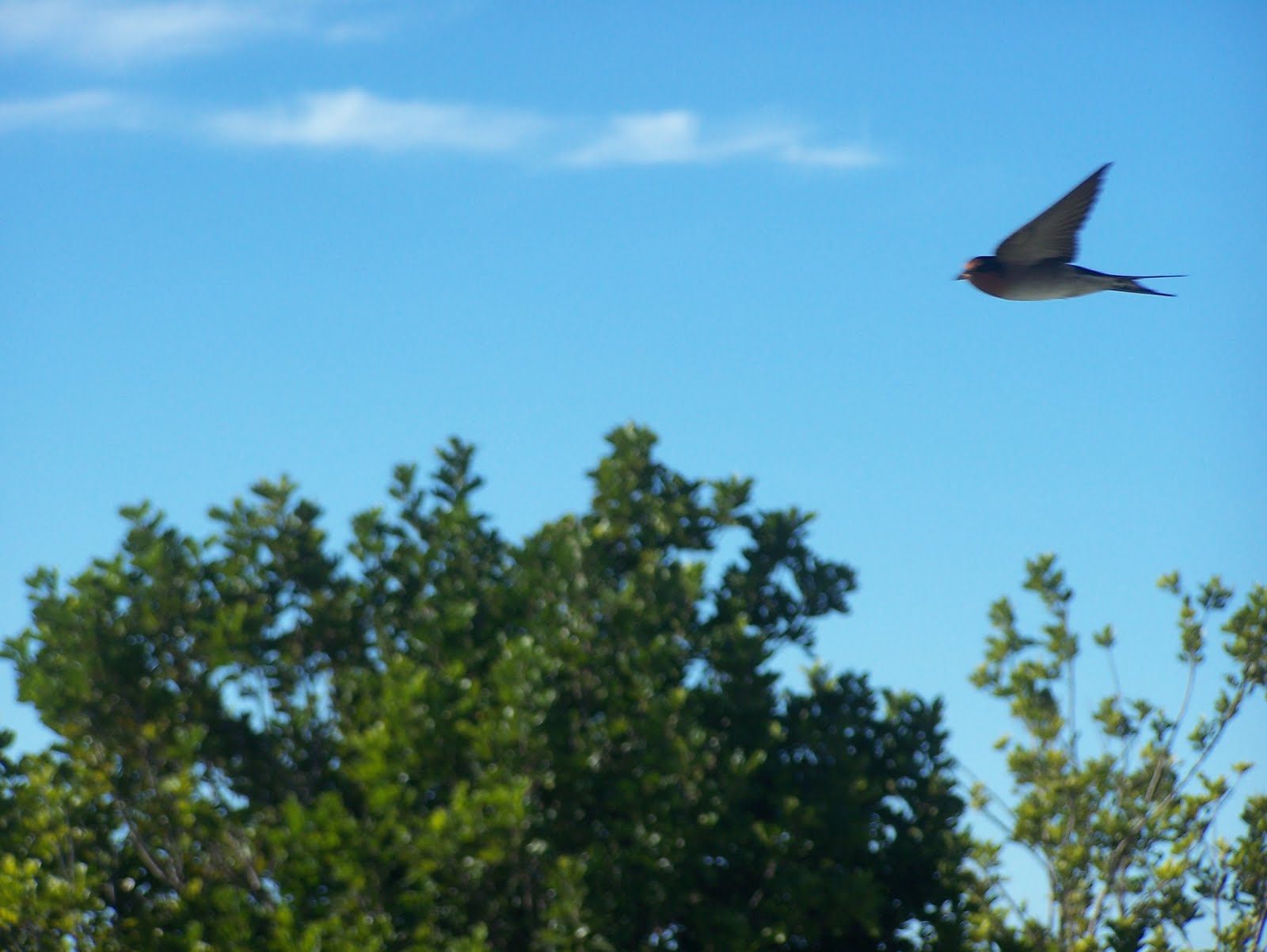
From the balcony of the Zorro Hotel, Batemans Bay, NSW:

Also got this shot, which is out of focus, yes, but I think it's still pretty cool. Although I think the shadow shot is better.


Also got this shot, which is out of focus, yes, but I think it's still pretty cool. Although I think the shadow shot is better.
Cockatoo in the House
Labels:
australia,
birds
0
comments
Just working at my computer, in the corner of the living room next to the veranda window. Just heard a noise behind me: a cockatoo had walked in the open door, grabbed the bottle full of seeds we keep behind the couch, and was trying to drag it out the door. Christine just gave him a little to get him to knock it off.


The Jesus Bird
Labels:
australia,
birds,
fauna,
northern territory
0
comments
From a 2006 trip to the Northern Territory: The Comb-crested Jacana, [links fixed] according to the very knowledgeable and talkative guide on the South Alligator River in Kakadoo National Park (part of the Yellow Waters cruise), has the longest feet, per bird size, of any bird in the world. Allows in to "walk on water."

Here are some drawings of the Comb-crested jacana by John Gould. And more. And more on Gould himself.
Update: I posted this, then seconds later went, "Oh, it's Easter." I wish I could say it was intentional.
The Comb-crested Jacana or Lotusbird is a waterbird with long legs and extremely long toes that enable it to walk on the leaves of floating plants. It is brown above with white face and front of neck. The back of the neck is black extending into a black band round the belly. The rest of the underside is white. It has red bill with black tip and pink comb on forehead.
Here are some drawings of the Comb-crested jacana by John Gould. And more. And more on Gould himself.
Update: I posted this, then seconds later went, "Oh, it's Easter." I wish I could say it was intentional.
Eels, Leeches, And a Giant Spider on My Face [updtd]
Labels:
Animals,
birds,
fish,
marsupials,
parks
0
comments
So you're in Australia. In the southeastern state of New South Wales, the North Carolina of Australia. In Sydney. (Let's call it Wilmington). Go straight north from the city center about 20 miles, er, about 32 kilometers, and you run into Ku-ring-gai Chase National Park.
Now you all know where to search for my body.
Right. To the latest excursion.
I entered the park at the Ku-ring-gai Wildflower Garden, and soon heard a "knocking on a hollow wood box" bird-call I am completely unfamiliar with. Five-second video:
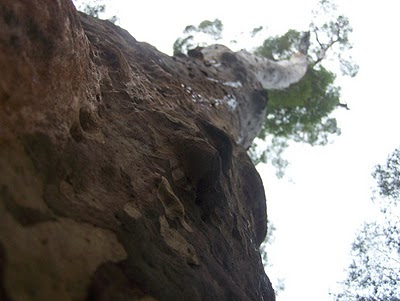
I unfortunately do not know the type of this gum (eucaplyptus) tree, but it is a big, beautiful, splotchy specimen:

So I'm taking a big step down from one rock to another when I go full face into a thick spider web. Hooray for me. I get as much web off my face and out of my hair as possible, hoping that no giant spider was on my head, and amble on. About a minute later I feel something walking on my left cheek. It was, of course, a giant spider.

This is Nephila edulis, the Gold Orb Weaver. Not much power in their venom—localized pain and swelling is all—but they're big. I unfortunately seem to have dislodged a leg or two from her. (Yes, her: the males are much smaller.) Sorry about that, spider.
Now here's a very cool thing I just learned via this hike. I got a few shots of a big brown bird that seemed very curious about me. Almost looked hawkish [update, April 18, 2011: Christine found a hawkish story!], but also kind off dovish.

A little closer:

I had no idea what it was, but this fantastic website, Birds in Backyards, has a Bird Finder: You enter in relative size, color, body type, and tail type, and it will suggest a possible bird. I did just that with this bird—and found my bird: a Brown Cuckoo Dove. No question about it. Here are some more pics. And here's its backside, just because:

If anyone can give me a clue as to what kind of flower this is, it'd be greatly appreciated. Christine guessed oleander, but that's not quite right. Related maybe?

I came to Cowan Creek, and saw some strange animal tracks. I have no idea what they are - but I just found a photo on Flickr of what some dude says is swamp wallaby tracks. They're just like my tracks here!
I saw a wallaby, a swamp wallaby, I'm sure, as they're the only ones in these parts, as far as my reading tells me. It was a beautiful dark chocolate brown, and its back appeared out of a large ferny area as it hopped away from me. No pic, alas: I chased it, of course, but wallabies are a bit faster than humans.
I did get a pic of an eel, or, like the cobbler catfish, an eel-like fish. Huge, maybe three feet long.

Video of another, smaller one:
I think they're Long-finned Eels. Fascinating!
More here.
While filming that first eel, I had the holy crap scared out of me by a huge, fat owl, or owl-like bird, that flew out of a tree just above the creek and made a getaway. The camera, flying violently around, as it often just does, unfortunately did not capture anything but the sound of its esccape.
I looked down at my feet at one point, and saw blood. Leeches. Again.
Then, whilst picking leeches from by bloody feet, a tiny bird came to visit, just a few feet away. Once again I fed some info into the Birds in Backyards bird finder tool, and, I found the Yellow Breasted Robin.
She's a beauty, isn't she?

Now you all know where to search for my body.
Right. To the latest excursion.
I entered the park at the Ku-ring-gai Wildflower Garden, and soon heard a "knocking on a hollow wood box" bird-call I am completely unfamiliar with. Five-second video:
I unfortunately do not know the type of this gum (eucaplyptus) tree, but it is a big, beautiful, splotchy specimen:


So I'm taking a big step down from one rock to another when I go full face into a thick spider web. Hooray for me. I get as much web off my face and out of my hair as possible, hoping that no giant spider was on my head, and amble on. About a minute later I feel something walking on my left cheek. It was, of course, a giant spider.

This is Nephila edulis, the Gold Orb Weaver. Not much power in their venom—localized pain and swelling is all—but they're big. I unfortunately seem to have dislodged a leg or two from her. (Yes, her: the males are much smaller.) Sorry about that, spider.
Now here's a very cool thing I just learned via this hike. I got a few shots of a big brown bird that seemed very curious about me. Almost looked hawkish [update, April 18, 2011: Christine found a hawkish story!], but also kind off dovish.

A little closer:

I had no idea what it was, but this fantastic website, Birds in Backyards, has a Bird Finder: You enter in relative size, color, body type, and tail type, and it will suggest a possible bird. I did just that with this bird—and found my bird: a Brown Cuckoo Dove. No question about it. Here are some more pics. And here's its backside, just because:

If anyone can give me a clue as to what kind of flower this is, it'd be greatly appreciated. Christine guessed oleander, but that's not quite right. Related maybe?

I came to Cowan Creek, and saw some strange animal tracks. I have no idea what they are - but I just found a photo on Flickr of what some dude says is swamp wallaby tracks. They're just like my tracks here!
I saw a wallaby, a swamp wallaby, I'm sure, as they're the only ones in these parts, as far as my reading tells me. It was a beautiful dark chocolate brown, and its back appeared out of a large ferny area as it hopped away from me. No pic, alas: I chased it, of course, but wallabies are a bit faster than humans.
I did get a pic of an eel, or, like the cobbler catfish, an eel-like fish. Huge, maybe three feet long.

Video of another, smaller one:
I think they're Long-finned Eels. Fascinating!
The larvae of Long-finned eels (glass eels, ~58 mm length) enter estuaries and migrate upstream to freshwater habitats where they may remain for up to 52 years before returning to the ocean to spawn and die.
More here.
While filming that first eel, I had the holy crap scared out of me by a huge, fat owl, or owl-like bird, that flew out of a tree just above the creek and made a getaway. The camera, flying violently around, as it often just does, unfortunately did not capture anything but the sound of its esccape.
I looked down at my feet at one point, and saw blood. Leeches. Again.
Then, whilst picking leeches from by bloody feet, a tiny bird came to visit, just a few feet away. Once again I fed some info into the Birds in Backyards bird finder tool, and, I found the Yellow Breasted Robin.
She's a beauty, isn't she?

Laughing Kookaburra
Labels:
Animals,
australia,
birds
0
comments

Also from my 2006 trip, this is a Laughing Kookaburra, one of four kookaburra species, and the only one in the Sydney region.
Kookaburras are related to the little fellow I posted just below: They're members of kingfisher family, but while the one featured below is a river kingfisher, the kookaburra is a tree kingfisher. They're carnivores, too, but rather than fish they eat insects, worms, crustaceans, reptiles, frogs, snakes, mice, and even chicks of other birds.
They are most famous for their call, which begins at our place right around 4:15 every morning:
According to an Aboriginal legend, the kookaburra's famous chorus of laughter every morning is a signal for the sky people to light the great fire that illuminates and warms the earth by day. The legend captures the imagination, but the true function of the familiar cacophony is to advertise the territory of this bold bird. The Laughing Kookaburra is the largest of the kingfisher family, but unlike most of its relatives, it is sedentary and occupies the same territories the year round.This site says that early European settlers described the call "appalling as the ravings of a madman . . . and ends in a prolonged sardonic chuckle."
Here's an example, but without the characteristic "hoo hoo hoo" start. This is just a raspy call.
The same site says this:
The name kookaburra is derived from an Aboriginal name, similar to the onomatopoeic words from other Aboriginal languages, including akkaburra, googooburra, gurgara, gingara and arkooburra.More:
Laughing Kookaburras are believed to pair for life. The nest is a bare chamber in a naturally occurring tree hollow or in a burrow excavated in an arboreal (tree-dwelling) termite mound. Both sexes share the incubation duties and both care for the young. Other Laughing Kookaburras, usually offspring of the previous one to two years, act as 'helpers' during the breeding season. Every bird in the group shares all parenting duties.I actually saw one emerge from a termite nest on a tree once. Thought it was a little cream-colored rodent at first, then off it flew. Here's a photo of a termite mound on a tree with holes that were likely once entrances to a kookaburra nest:

The Laughing Kookaburra.

Azure Kingfisher
Labels:
birds,
fauna,
northern territory
0
comments
From my trip to Australia in 2006.

Australian Museum:
Saw this little guy, a cousin of the kookaburra and only three of four inches high, on the South Alligator River in Kakadu National Park. Several times he'd dart down, be back up on the limb and have his food down almost faster than you could see.
Australian Museum:
The Azure Kingfisher plunges from overhanging perches into water to catch prey. Prey items include: fish, crustaceans, aquatic insects and other invertebrates, and, sometimes, frogs. They will often bash their prey against the perch before swallowing it head first. Often watch Platypuses foraging underwater and catch any food items that are disturbed.
Saw this little guy, a cousin of the kookaburra and only three of four inches high, on the South Alligator River in Kakadu National Park. Several times he'd dart down, be back up on the limb and have his food down almost faster than you could see.
How to Barbecue Cockatoo
Labels:
australia,
birds
0
comments
 |
| Shrimps on the barbie is for wusses |
Since the invasion of the cockatoos—just two posts below this one—we've had at least one cockatoo visit us every day. Yesterday one came and stayed for half an hour or so. It had a distinctive orange mark on the left side of its neck:

We call him/her Rusty. I put out a plastic container with some wild bird seed in it, which I thought Rusty would eat from. No. Rusty promptly picked the container up in one of his nimble little feet, spilling most of the seeds, and held it up to his mouth while he casually picked at what remained. Video (during which I forget how to talk):
Rusty came back this morning. Today he flew away with the container and dropped it in the neighbor's driveway.
More shots, and a few damn fine ones, if I do say so myself, follow.

Cockatoos and frangipani flowers go together quite nicely, don't they?


A little closer:

And this one (click on photo to enlarge, and click again to get really close) lets you really see the grains of the feathers:

Subscribe to:
Posts (Atom)