Don't quite know how this happens, but these guys are simply unafraid of people. It's probably something that's been passed down through many generations—evidenced by the fact that these four are made up of a mating pair and their two young (they ocassionally feed them via their crops still), who they have already taught that humans like us are suckers.
Full video, with exciting (not exciting) pixellation interruptions for first minute-and-a-half:
Rainbow lorikeets (Trichoglossus haematodus) information at Birds In Backyards.
Showing posts with label australia. Show all posts
Showing posts with label australia. Show all posts
Carnivorous Butcherbird on Veranda
Labels:
australia,
birds,
collaroy
0
comments
This little guy has been visiting nearly every day for some weeks now.

It's a relative of the magpie.
Rear view:

The other day, alongside a visiting lorikeet:

It's a Grey butcherbird:
Like the magpies, butcherbirds are carnivores:
Good shots of the hook on its beak, and great audio of it's beautiful song, here.
Updated: This post has been edited - as I mistakenly said butcherbirds were related to the kingfishers. They are not! I am very sorry!

It's a relative of the magpie.
Rear view:

The other day, alongside a visiting lorikeet:

It's a Grey butcherbird:
The adult Grey Butcherbird has a black crown and face and a grey back, with a thin white collar. The wings are grey, with large areas of white and the underparts are white. The grey and black bill is large, with a small hook at the tip of the upper bill. The eye is dark brown and the legs and feet are dark grey. Both sexes are similar in plumage, but the females are slightly smaller than the males. Young Grey Butcherbirds resemble adults, but have black areas replaced with olive-brown and a buff wash on the white areas. The bill is completely dark grey and often lacks an obvious hook. They are sometimes mistaken for small kingfishers.I walked by the veranda door this morning and this little guy was standing on the edge of a flower pot looking in at me like, "Where's my brekkie?"
Like the magpies, butcherbirds are carnivores:
Grey Butcherbirds are aggressive predators. They prey on small animals, including birds, lizards and insects, as well as some fruits and seeds. Uneaten food may be stored in the fork or a branch or impaled. Grey Butcherbirds sit on an open perch searching for prey which, once sighted, they pounce on. Most mobile prey is caught on the ground, though small birds and insects may be caught in flight. Feeding normally takes place alone, in pairs or in small family groups. That's a little piece of mince - ground beef - in his beak.Here's video of this morning's butcherbird, with a little piece of mince - ground beef - to fly away with. (You can pause it to see the whiskers that jut out from the base of its beak.)
Good shots of the hook on its beak, and great audio of it's beautiful song, here.
Updated: This post has been edited - as I mistakenly said butcherbirds were related to the kingfishers. They are not! I am very sorry!

Aussie Coroner: The Dingo Did It [updtd]
Labels:
australia,
culture
0
comments

Wow.
Full story should be here very soon.
Update: Here it is:
Dingo caused baby Azaria Chamberlain's death - coroner
An Australian coroner has made a final ruling that a dingo dog took baby Azaria Chamberlain from a campsite in 1980 and caused her death.
The decision was made after Azaria's parents presented new evidence to try to clear their names.
After the eight week-old baby went missing, they were charged with her disappearance, and mother Lindy Chamberlain-Creighton with her murder.
She was released when evidence matched the dingo story but doubts lingered.Extra: Bad dingo.
Photo from here.
The Christmas Beetle
Labels:
australia,
insects
0
comments
I was reading on the veranda late the other night when I was suddenly bombarded by what could have been empty walnut shells. I actually thought someone was throwing things at me - some drunk neighbor, not an uncommon thing - then I saw beetle in a planter:

I picked it up and got some shots, most of which did not come out because it was too dark. One good one:
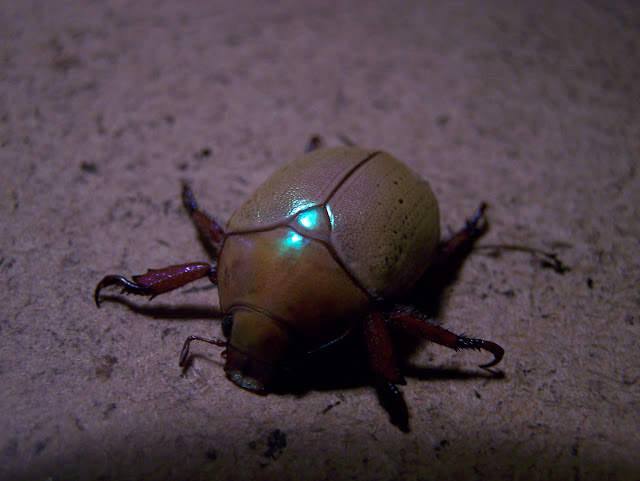
Look at those claws!
Here's a beetle butt:

I put the beetle back into the planter, and in thirty seconds or so it was gone—dug down into the soil. Ah, I thought, "it" is a "she," and she's gone to lay some eggs. Research must be done...
Christine's sister Shannon said she thought it was a Christmas Beetle. They show up every summer, and, she said, look like our friend here.
She's right, no doubt about it. And I was right that she was going to lay eggs. Photo here; life cycle description here:

I picked it up and got some shots, most of which did not come out because it was too dark. One good one:
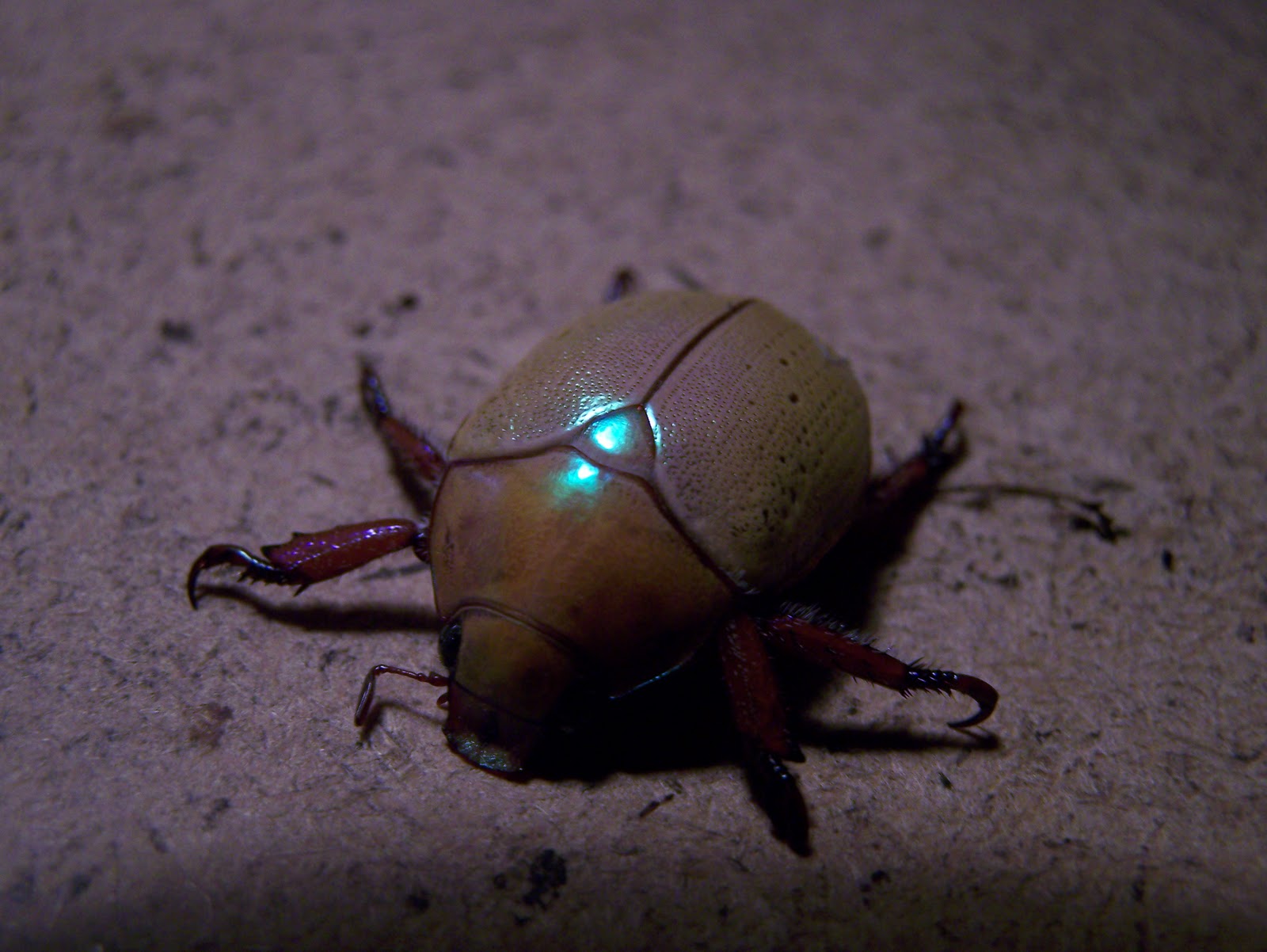
Look at those claws!
Here's a beetle butt:

I put the beetle back into the planter, and in thirty seconds or so it was gone—dug down into the soil. Ah, I thought, "it" is a "she," and she's gone to lay some eggs. Research must be done...
Christine's sister Shannon said she thought it was a Christmas Beetle. They show up every summer, and, she said, look like our friend here.
She's right, no doubt about it. And I was right that she was going to lay eggs. Photo here; life cycle description here:
The life cycle of a Christmas beetle is from one to two years. The larvae of Christmas beetles live and develop in the soil for about a year, eating decaying organic matter and plant roots of mainly native grasses and other vegetation. In agricultural land larvae can feed on the roots of crops and pasture. In urban areas larvae often feed on the roots of turf. This feeding can cause plants to turn yellow and wither.
Toward the end of winter the larvae move closer to the soil surface and pupate. The adults emerge several weeks later and dig their way out of the soil. They then fly to the nearest food plant to feed. And of course their other main duty at this stage is to mate. They then lay eggs in the soil close to their food source.There are 35 different species, 8 in the Sydney area. And I may have to dig up those eggs, put them in soil in a glass jar, and watch them. Stay tuned...
Melbourne Cup Day
Labels:
australia,
culture
0
comments
Today is the day of the Melbourne Cup, otherwise known as the Stanley Cup of Horse Racing (by me, only me.)
It is an event of such import in Australia that in the state of Victoria it is an official holiday. Really. In the rest of Australia, it is not an official holiday, but is by many treated as one.
A few of the rels will be coming over for snacks, champagne, and pavlova. We'll head down to he TAB and have a flutter. All around good fun. If we win a big one we'll let you know...in a month or two.
It is an event of such import in Australia that in the state of Victoria it is an official holiday. Really. In the rest of Australia, it is not an official holiday, but is by many treated as one.
A few of the rels will be coming over for snacks, champagne, and pavlova. We'll head down to he TAB and have a flutter. All around good fun. If we win a big one we'll let you know...in a month or two.
Magpies With Chick; Crested Pigeons' Mating Dance
Labels:
australia,
birds
0
comments
I got two nice videos yesterday.
In this first one I say that what we have here is two currawongs and their chick. Why? Because I'm an idiot. They're magpies, and I should have known that. (I've been told the way to distinguish the two is that the magpies have white on their beaks, and currawongs don't.)
Just minutes later a pair of Australian Crested Pigeons showed up on the same roof, and performed a beautiful mating dance, with tails rising and opening and heads bobbing. Really nice:
In this first one I say that what we have here is two currawongs and their chick. Why? Because I'm an idiot. They're magpies, and I should have known that. (I've been told the way to distinguish the two is that the magpies have white on their beaks, and currawongs don't.)
Just minutes later a pair of Australian Crested Pigeons showed up on the same roof, and performed a beautiful mating dance, with tails rising and opening and heads bobbing. Really nice:
Australian Crested Pigeon
Labels:
australia,
birds
0
comments
We've had s regular vistor (along with the cockatoos) for the last couple weeks. We first got to know him (her?) by the sound of his flight: a buffeting whistle and hum, kind of like a partridge or quail, but louder and tighter.

Cute fella, huh? It's a Crested Pigeon, native to Australia.
He's been back almost every day since. Very comfortable, will poke around right next to the much larger cockies, let's us walk out and talk to him.
Here he is doing a fluff-up:

I'll try to get some audio of the wing sound:

If startled, this pigeon takes to the air with a characteristic whistling flight, and glides with down turned wings. The whistling sound is produced by the air passing over a modified primary feather on the wing.Before long we saw him on the veranda, poking around for leftover seeds or whatever else he could find.

Cute fella, huh? It's a Crested Pigeon, native to Australia.
He's been back almost every day since. Very comfortable, will poke around right next to the much larger cockies, let's us walk out and talk to him.
Here he is doing a fluff-up:

I'll try to get some audio of the wing sound:
If startled, this pigeon takes to the air with a characteristic whistling flight, and glides with down turned wings. The whistling sound is produced by the air passing over a modified primary feather on the wing.You get a little better look at the wonderful wing colors here:

The Aussie Meat Pie
Labels:
australia,
food
0
comments
Behold, it is a pair of Aussie Meat Pies, seen here in their natural habitat, their flaky top crusts liberally adorned with the requisite tomato sauce.

Here they are again, seconds later, the victims, one gathers darkly, of a most brutal and savage attack.

And why do Aussies eat the Aussie Meat Pie? Because of the "classic taste of meat and gravy" is why.

Classic.

Here they are again, seconds later, the victims, one gathers darkly, of a most brutal and savage attack.

And why do Aussies eat the Aussie Meat Pie? Because of the "classic taste of meat and gravy" is why.

Classic.
Tasmanian Tiger Hunted to Extinction For No Good Reason
Labels:
australia,
history,
marsupials
0
comments

Add another layer of depressing to the story of the Tassie Tiger:
The thylacine (Thylacinus cynocephalus), better known as the Tasmanian tiger, has long been the poster child for human-caused extinction. Hunted out of existence by Australian farmers who feared that the striped, canine-like marsupials would kill their sheep, the last thylacine died in captivity in Hobart Zoo 75 years ago next week, on September 7, 1936 (although the species was not officially declared extinct until about 25 years ago).
Now, just a few days before the annual observance of National Thylacine Day in Australia, a new study reveals that the predator was probably not a threat to sheep after all. Its notably long jaw (one of the animal’s most distinctive features) could open to an amazing 120 degrees but was too weak to kill sheep, according to a study published September 1 in the Journal of Zoology.
Great. (The 120° claim is a commonly repeated myth, I've read, just to note. They could open their mouths very wide, maybe to near 80°.)
Look at this beautiful animal, a marsupial dog:
That's video of the very last one ever known to exist.
[photo]

Missing Man Found Dead in Outback
Labels:
australia,
outback
0
comments
Another in a long list of Outback mysteries:
A body believed to be that of missing Victorian man Jason Richards has been found about one kilometre from his abandoned car in the South Australian outback.
[...]
The disappearance of Mr Richards, 28, was declared a major crime after he failed to arrive in his home town of Ballarat after leaving Darwin in June.
[...]
The man's burnt-out boat was found on a track near Pimba, south of Woomera, in June, and his pet dog turned up south-east of Glendambo about two-and-a-half weeks ago.
On Friday afternoon, a fox shooter discovered Mr Richards' ute in scrub about 10 kilometres south of Glendambo.
White-Faced Heron, Tide Pools [updated]
Labels:
Animals,
australia,
birds,
marine life
0
comments
A few shots from local beaches.
This beautiful bird was walking around down by the collaroy tide pools. It was about three feet tall, and it's a White-faced Heron:


An interesting fact about these birds:
"Nuptial plumes." Sexy.
Here's a bit of Eastern Rock Lobster (mentioned previously here):


A beautiful snail of some sort. Alive. (Update: Old friend Sara in the UK informs me that this is a cowry. Probably this one. It is a type of sea snail, but, as you can see, it has a uniquely shaped shell. Thank you, Sara!):

Same snail, underside:

This just to make my golfing friends jealous. The golf course about a twenty minute walk from home:

Some kind of tide pool creatures' homes washed up on the beach:

Weird, gelatinous creatures in a tide pool crevice:

One of the above creatures out of crevice:

Evidence of ancient beach civilization:

The lovely rocks of the upper tide pool area:

This beautiful bird was walking around down by the collaroy tide pools. It was about three feet tall, and it's a White-faced Heron:


An interesting fact about these birds:
When breeding, the birds have long feathers (nuptial plumes) on the head, neck and back.
"Nuptial plumes." Sexy.
Here's a bit of Eastern Rock Lobster (mentioned previously here):


A beautiful snail of some sort. Alive. (Update: Old friend Sara in the UK informs me that this is a cowry. Probably this one. It is a type of sea snail, but, as you can see, it has a uniquely shaped shell. Thank you, Sara!):

Same snail, underside:

This just to make my golfing friends jealous. The golf course about a twenty minute walk from home:

Some kind of tide pool creatures' homes washed up on the beach:

Weird, gelatinous creatures in a tide pool crevice:

One of the above creatures out of crevice:

Evidence of ancient beach civilization:

The lovely rocks of the upper tide pool area:

Aussie Dentist
Labels:
australia,
health care
0
comments
Me: Tooth face neck hurt ow.
Aussie Dentist: Hmm. [needle needle] Let's just pop that sucker out.
Me: Rnph ow?
AD: Sure, why not.
[AD grabs pliers, stands up, leans over, reaches into mouth, pulls out right top rear wisdom tooth]
AD: Smell that. [holds freshly extracted tooth to my nose]
Me: GAH!
That was my first gone wisdom tooth. AD asked if I wanted him to use one of his dental drills to drill a hole through it so I could put some string through it and wear it around my neck. While I have no plans to wear my gone wisdom tooth around my neck, I said Of course.

That is one nasty looking tooth.
Cost of emergency visit, x-ray, tooth extraction, temporary filling in cavity exposed after extraction: $290 AUS (about the same as US dollars). That's possibly close to what it would cost in the U.S., not sure, but I think it's a bit cheaper.
Aussie Dentist: Hmm. [needle needle] Let's just pop that sucker out.
Me: Rnph ow?
AD: Sure, why not.
[AD grabs pliers, stands up, leans over, reaches into mouth, pulls out right top rear wisdom tooth]
AD: Smell that. [holds freshly extracted tooth to my nose]
Me: GAH!
That was my first gone wisdom tooth. AD asked if I wanted him to use one of his dental drills to drill a hole through it so I could put some string through it and wear it around my neck. While I have no plans to wear my gone wisdom tooth around my neck, I said Of course.

That is one nasty looking tooth.
Cost of emergency visit, x-ray, tooth extraction, temporary filling in cavity exposed after extraction: $290 AUS (about the same as US dollars). That's possibly close to what it would cost in the U.S., not sure, but I think it's a bit cheaper.
2 Lorikeets, 1 Mirror
Two wild lorikeets, taken by son-in-law Hans on his veranda. (The moment at about the 25 second mark, when the one bird's head goes over the others - while looking into his own face - is hilarious.)
Lizard
Took this photo in 2006. East of Canberra got out of the car for some reason or other, saw this little guy not far from the road digging a little hole. I don't know what type of lizard he is. I'll try and find out.
Look at the back legs on that sucker.

Look at the back legs on that sucker.
Crab
Labels:
Animals,
australia,
marine life,
photos,
travel
0
comments
Crab in a pool of shells, Pebbly Beach, South Coast, NSW:


Cockatoo in the House
Labels:
australia,
birds
0
comments
Just working at my computer, in the corner of the living room next to the veranda window. Just heard a noise behind me: a cockatoo had walked in the open door, grabbed the bottle full of seeds we keep behind the couch, and was trying to drag it out the door. Christine just gave him a little to get him to knock it off.


"Dead 10m whale lures sharks to Newport Beach" [updts]
Labels:
australia,
cetaceans
0
comments
Update I: Got pics.
 Just a few miles down the road. Going to see it right now. Yay! (Yay for possibly seeing sharks, I mean.)
"AUTHORITIES are considering cutting up the carcass of a 10m sperm whale, which is attracting sharks to Sydney's Newport Beach.

The young whale. They say it's about four years old, thirty feet long—weighs twelve tons.

No sharks in sight. Tomorrow at low tide they'll try to cut it up with chainsaws, load it in trucks and bury it somewhere.
Update II: As of Saturday the whale has been cut up with chainsaws and trucked away. The beach is still closed, as more sharks have been seen in the area, drawn in by the whale blood.

"AUTHORITIES are considering cutting up the carcass of a 10m sperm whale, which is attracting sharks to Sydney's Newport Beach.
The body of the wedged amphibian has drawn schools of sharks to the popular surfing spot, forcing the beach to be closed.Back now. Got some pics. There were about 50 people down there, an air of excitement. The whale is at the end of the rock.
Local residents are flocking to the scene, but not for long, as the smell of rotting flesh wafts throughout nearby Newport village."

The young whale. They say it's about four years old, thirty feet long—weighs twelve tons.

No sharks in sight. Tomorrow at low tide they'll try to cut it up with chainsaws, load it in trucks and bury it somewhere.
Update II: As of Saturday the whale has been cut up with chainsaws and trucked away. The beach is still closed, as more sharks have been seen in the area, drawn in by the whale blood.
The Jesus Bird
Labels:
australia,
birds,
fauna,
northern territory
0
comments
From a 2006 trip to the Northern Territory: The Comb-crested Jacana, [links fixed] according to the very knowledgeable and talkative guide on the South Alligator River in Kakadoo National Park (part of the Yellow Waters cruise), has the longest feet, per bird size, of any bird in the world. Allows in to "walk on water."

Here are some drawings of the Comb-crested jacana by John Gould. And more. And more on Gould himself.
Update: I posted this, then seconds later went, "Oh, it's Easter." I wish I could say it was intentional.
The Comb-crested Jacana or Lotusbird is a waterbird with long legs and extremely long toes that enable it to walk on the leaves of floating plants. It is brown above with white face and front of neck. The back of the neck is black extending into a black band round the belly. The rest of the underside is white. It has red bill with black tip and pink comb on forehead.
Here are some drawings of the Comb-crested jacana by John Gould. And more. And more on Gould himself.
Update: I posted this, then seconds later went, "Oh, it's Easter." I wish I could say it was intentional.
Surf Fishing: Flathead and Mystery Crab
Labels:
Animals,
australia
0
comments
I went fishing yesterday. (Was it a Good Friday thing? Some smoke from a stirred childhood memory?) Christine came along, and spent some time trying to catch beach worms.

Now here's the weird thing: The flathead you catch surf fishing around here, the way I understand it, is the dusky flathead. But the dusky flathead, like all flathead species, I'm learning, has a characteristic tail:
Look at this fish's tail. Click on the pic and then again to zoom in.

You see those spots on the tail? I'm pretty sure that tells us this is a Northern flathead:
Here's an image of a tail.
I quickly got out my book and found that flathead have to be 33 centimeters, about 13 inches—to keep. This one was a few centimeters short, so back into the Pacific he went.
Christine gave up on the beach worms—they're so hard to catch—and went home. About an hour later I felt something tugging on my bait. I yanked the rod, and got something. It felt like a bigger fish that the first. I pulled it in and in the surf saw...what?...the hell is that...damn, it's a crab. He fell off right at the edge of the surf. I don't think I had hooked him—I think he just held on to that piece of pilchard for the whole ride to the beach.

I have no idea what kind off crab that is. My NSW fishing book lists just three that have size limits; this crab isn't one of those (mud crab maybe); for the rest there is no size limit.

Grrrr.

I put him back anyway. Can't cook up one little crab. He scampered and swam sideways back into the surf.
Just a few minutes in I caught a flathead on a little prawn (not fresh; been in the freezer for ages). Clean, hard strike, I didn't have to set the hook, it just took it and ran. Christine took a shot of the hook removal:

Now here's the weird thing: The flathead you catch surf fishing around here, the way I understand it, is the dusky flathead. But the dusky flathead, like all flathead species, I'm learning, has a characteristic tail:
Dusky Flathead are easily distinguished from other flathead by the distinctive black spot circled in blue on their tail fin.
Look at this fish's tail. Click on the pic and then again to zoom in.

You see those spots on the tail? I'm pretty sure that tells us this is a Northern flathead:
The Northern Flathead has a pale brown body speckled with pinkish-red spots. The caudal fin (tail) is the best way to identify the northern sand flathead, with a pattern of almost horizontal flag-like black stripes across the tail (three distinct black bars on the upper portion and two on the lower portion of the caudal fin).
Here's an image of a tail.
I quickly got out my book and found that flathead have to be 33 centimeters, about 13 inches—to keep. This one was a few centimeters short, so back into the Pacific he went.
Christine gave up on the beach worms—they're so hard to catch—and went home. About an hour later I felt something tugging on my bait. I yanked the rod, and got something. It felt like a bigger fish that the first. I pulled it in and in the surf saw...what?...the hell is that...damn, it's a crab. He fell off right at the edge of the surf. I don't think I had hooked him—I think he just held on to that piece of pilchard for the whole ride to the beach.


Grrrr.

I put him back anyway. Can't cook up one little crab. He scampered and swam sideways back into the surf.
Easter in Australia
Labels:
australia,
culture
0
comments
 |
| Christine's buns |
It's Good Friday, and Easter in Australia has officially begun. Most shops are closed, everyone has a federal holiday today and Monday, and huge feasts will be taking place all over the drab continent this weekend. (Drab? Did I just say that?) We will even be having the rels over for a feast here at our place on Sunday. All good stuff.
I'll update this diary throughout the weekend as I notice things about Easter in Australia that Americans, and maybe even an Australian or two, might find notable.
Hot Cross Buns. I'll start by saying that Easter unofficially started last week, when Christine started making regular loads of homemade hot cross buns—pictured above—the Easter treat in Australia. (I've just had my morning dose of halved hot cross buns toasted and slathered with butter.) To give you an idea of the strength of this tradition: There was an article in the local free daily (which doesn't come out on Sunday…or Monday) about how some un-Australian bakers were messing with the traditional hot cross bun recipe and adding sacrilegious bits like chocolate and coffee. The outrage! (The news!)
Smoked Fish Cooked in Milk. While I'm here at the computer working on an article right now (well, not right now, or practically ever…), Christine is making us smoked fish and eggs. The smoked fish (cod, in this case) is cooked in milk. It's what you do on Good Friday, or maybe just around Easter, apparently. Christine doesn't know the origin, though it must have to do with Lent, and the meatless Fridays that had us Catholic kids eating store-bought fish sticks on Fridays in Buffalo.
Subscribe to:
Posts (Atom)