Showing posts with label fauna. Show all posts

Peg, the One-Footed Cockatoo

0 comments

Wild, one-footed cocky that comes to visit several times a week, on a chair on the veranda. You can see the little stump of her left leg there. (Click on photo to enlarge.)


And: A typical morning at the Little Australia household.

One-Legged Cockatoo

0 comments
Here's a video of the one cockatoo we still feed. Her name is Peg:


And seconds after I stopped that video, Peg flew off with the dish. Cheeky bugger:


And this poor bugger looks like something out of a horrror movie:


We believe this bird to be suffering from Psittacine beak and feather disease. It is no fun:
Psittacine beak and feather disease is a viral disease affecting all Old World and New World Parrots (Psittacini, Hookbills). The virus belongs to the family Circoviridae. The virus attacks the feather follicles and the beak and claws-growing cells of the bird, causing progressive feather malformation and necrosis. In later stages of the disease, the feathers develop constrictions in feather shafts, cease development early until eventually all feather growth stops.


We saw something in the paper saying that you should actually try to capture these birds and take them to the local WIRES, as the disease is communicable. We'll look into that some more before actually throwing a blanket over one. Poor fella.

2 Lorikeets, 1 Mirror

0 comments
Two wild lorikeets, taken by son-in-law Hans on his veranda. (The moment at about the 25 second mark, when the one bird's head goes over the others - while looking into his own face - is hilarious.)

Beach Kangaroos, Manta Rays, and Seawater-Drinking Birds

0 comments
So we went down to Batemans Bay and region, south of Sydney on the NSW coast, a few weeks ago, and saw beach kangaroos. The first one was in Pebbly Beach, just lounging on a sandy dune.


It's an Eastern Grey Kangaroo. They're not generally associated with beaches, but it appears that some have adapted. And we actually saw tracks on the beach that clearly showed that kangaroos had gone into the surf! I would have loved to see that.
A short video of the roo and the beach:


We saw several more in a much more lush area just off the beach in Murramurang National Park.


Yes, we did call this one "Ilene":


Christine narrates:


A small guy showing off his creamy winter coat:


Mama roo and joey:


We then drove up the coast just a little ways, to Bawley Point, where we were lucky enough to stop at a newsagents shop, where the proprietor was also the local tourist info guy. He told us about a few places, including one where you can "see the rays" from an old dock. "They're always there," he said. We were skeptical. We shouldn't have been.


Christine did a little research and was able to identify this long-red-billed bird as a Sooty Oyster Catcher:


The Sooty Oystercatcher feeds on molluscs, crabs and other crustaceans, marine worms, starfish and sea urchins, and small fish. It uses its long bill to stab at prey or to lever, prise or hammer open food items. It drinks seawater.

Drinks seawater. I don't think I've ever heard of that. But I've just did some googling, and found out that many sea birds drink seawater. Fascinating!


And this little fella is a Willy Wagtail:


The Jesus Bird

0 comments
From a 2006 trip to the Northern Territory: The Comb-crested Jacana, [links fixed] according to the very knowledgeable and talkative guide on the South Alligator River in Kakadoo National Park (part of the Yellow Waters cruise), has the longest feet, per bird size, of any bird in the world. Allows in to "walk on water."


The Comb-crested Jacana or Lotusbird is a waterbird with long legs and extremely long toes that enable it to walk on the leaves of floating plants. It is brown above with white face and front of neck. The back of the neck is black extending into a black band round the belly. The rest of the underside is white. It has red bill with black tip and pink comb on forehead.

Here are some drawings of the Comb-crested jacana by John Gould. And more. And more on Gould himself.

Update: I posted this, then seconds later went, "Oh, it's Easter." I wish I could say it was intentional.

Swamp Wallaby

0 comments
This is from the 2006 trip Christine and I took to Australia. We were driving into Ku-ring-gai Chase National Park north of Sydney when all of a sudden there it was, a swamp wallaby (we incorrectly say rock wallaby in the video), just sitting on the side of the road. What follows are, while still worth viewing, in my opinion, the kind of photographs and video you get when you are freaking out about seeing your very first wild wallaby.


You can almost hear the wallaby shake his head in the video, and say "If you would have just relaxed I would sat here and let you take pictures of me all day. I would have posed! You dope."

Much more on the swamp wallaby here.

Penguin Release

0 comments
They released rehabilitated penguins yesterday at a beach I could walk to in seven minutes. And I didn't know. Dammit.


Shark Release

0 comments
We went down to Collaroy Beach two weeks ago and witnessed the release of four young Wobeggong Sharks. It's all part of Project Wobbegong:
With shark populations collapsing worldwide and local wobbegong numbers in decline, the juveniles are part of a research program investigating whether sharks bred in captivity can thrive in the wild.

The joint venture between Sydney Aquarium and Macquarie University, called Project Wobbegong, is already a success, with 12 out of 17 individuals released setting up home in the area or returning on a regular basis.
A crowd gathered on the beach, waiting for the sharks, including camera crews.


And divers:


The shark truck finally arrived. I snapped a shot of the shark buckets:


The crew pulled one of the buckets out, and we get a little video, and some info on the sharks. You can also hear the caw of the Australian crow, which never ceases to crack me up:


Look at that pattern:


And the crazy release, during which I say "WOE be gone" - it's "WAH be gong."


Wobbegongs are flat, almost like catfish, and have supreme camoflage, which they use to lie in wait for prey. (They're also known as "carpet sharks.") They can grow to more than three meters, or about ten feet in length, can live up to thirty years, and are mostly harmless: they'll only bite if they've been severely provoked. These little guys are just over three  years old, and about 60 centimeters or about two feet long. There are actually eleven different species of Wobbegong shark, and I don't know which one these are, though I'm pretty sure they're Spotted Wobbegongs (Orectolobus maculatus), which are the largest of the bunch.

Wobbegong, according to some sources, means "shaggy beard" in an Aussie Aboriginal language.

On the way home, pelican arse:


And in the Collaroy Surf Club for a fish lunch, a message to employees from management:


And wo, look at this Wobbegong species. Crazy.

Stick Cocoon Creature, Banksia Man, and Singing Tree

0 comments
The eagle-eyed Christine stopped us yesterday on our hike in Ku-Ring-gai National Park, saying, "Thom, look at this."

I looked at this:


It was about four inches long. It was soft: you could squeeze it, like it was an empty sac. It smelled resiny.

"It's a cocoon," Christine said. "I remember them from when I was little."

I've just looked it up, and I quickly found a remarkably similar photo—even down to the way those outer sticks are configured: it's the cocoon (empty, pretty sure) of the caterpillar of a case moth, possibly the Saunders' Case Moth, Metura elongatus. Oh, you have to go here, too. And holy crap, here, too. (I've just realized, this is related to the "Walking Turd" from December, but a different species, clearly.)

Good eye, Christine.

Now here's Christine and a scary Banksia  Man. (Guess which ones which.)


Aren't she perty?

And a tree:

Oh, Vienna!

***

Christine suddenly burst out in song on the way home, singing along with a song on the radio that I'd never heard in my life.


The 2nd Most Deadly Snake in the World

0 comments
The eastern brown snake is the species responsible for most deaths caused by snakebite in Australia, although, with the advent of efficient first-aid treatment and antivenom, there are now usually only one or two deaths per year. A large adult brown snake is a formidable creature. They may exceed two metres in length and, on hot days, can move at surprising speed. It has a slender body and is variable in colour ranging from uniform tan to grey or dark brown. The belly is cream, yellow or pale orange with darker orange spots.

And I got to stick my camera in a brown snake's face today. Huuuhhh-zzzah!

One good way to identify the eastern brown:

When attacking, the brown snake winds its body into an 'S' shape, raising itself off the ground.

One not great pic. (This snake was scary fast.)


And a video. Stop it at the 22-second mark, and you can see the snake rise up into the distinctive brown snake "S" shape. (And you can hear Christine in the background say, in a way that means oh so much more than you know, "I think it's a brown snake Thom." She said that several more times in the few minutes I was with that snake.)


New Nudibranch Discovered in Gulf of Mexico

0 comments
Not to be outdone by Madagascar (post directly below this one), a new species of sea snail has been discovered off Florida:

Biologists with the Florida and Wildlife Conservation Commission (FWC), along with scientists from California State Polytechnic University, have identified a new marine species found in the Gulf of Mexico. A scientific publication released Thursday officially announced the discovery of Chromodoris fentoni, a type of shell-less snail known as a nudibranch.
Seems to be related to the sea hare I video'd a few months ago. Looks like they are.

New Lemur Species Discovered

0 comments
Amazing. Will they ever stop finding new species in Madagascar?


Mind the Fence

0 comments
Can I just say, in advance, "OWWWWWW!"

That is all.


Brush-tailed Possum, Dee Why, Sydney, Oz, October, 2006.

Azure Kingfisher

0 comments
From my trip to Australia in 2006.


Australian Museum:

The Azure Kingfisher plunges from overhanging perches into water to catch prey. Prey items include: fish, crustaceans, aquatic insects and other invertebrates, and, sometimes, frogs. They will often bash their prey against the perch before swallowing it head first. Often watch Platypuses foraging underwater and catch any food items that are disturbed.

Saw this little guy, a cousin of the kookaburra and only three of four inches high, on the South Alligator River in Kakadu National Park. Several times he'd dart down, be back up on the limb and have his food down almost faster than you could see.

Australia Reptile Park

0 comments
I hate and love zoos. Some I just hate, I guess. But many are very good at what zoos are supposed to be good at: fascinating humans while educating them about animals while being exceptionally mindful of the care of those animals. On that note, Christine and I went for a drive up north yesterday and came across the Australia Reptile Park. We were tired of driving and said What the hell and paid the $24 (!) to get in.

We will be going back. Possibly to work as volunteers.

First, a sign we saw in the park, helpfully illustrating the life cycle of the tasmanian devil (click to enlarge):


In case you didn't get that, kids:


Look at those faces: Mating is fun! And a little naughty! Like I said: educating and fascinating!

Moving on: The Australia Reptile Park is one of the country's most important wildlife parks/zoos. For starters: It's where the venom from what is commonly called the most deadly spider in the world, the Sydney funnel web spider, is "milked" from spiders in order to develop antivenom. (Here's how they do it!) That antivenom first became available in 1980: before that, deaths from funnel web bites weren't exactly common, but they did happen, and if you didn't die you suffered horribly and were in the hospital for weeks. Since development of the antivenom there has not been a single reported death from the bite of a Sydeny funnel web. Not one. You still suffer horribly—the funnel web's bite is extremely painful, and you'll still get fever and sweats and chills and nausea and pain and pain and pain—but you're only in the hospital for a couple days, rather than weeks and weeks.

  • Note: When Christine was a kid her grandfather died from a funnel web bite. She has a funny story about that. Honestly. Seems Grandpa was able to kill the spider—always helpful—and dear little Christine, about six at the time, was assigned the duty of holding said dead spider while they raced to the hospital. Once there, they were tending to grandpa and whatnot…when the "dead" funnel web spider…the most deadly spider in creation…started crawling across Christine's hand. But really, she should tell you the story…
The park, we found out from the very nice and very funny Ranger Mike, has about 600 venomous snakes - OH. MY. GOD. I am so going into the building - and they do regular venom milking on several of them of different species, as well as the venomous spider milking. They even have king cobras—the only zoo in Australia that has these snakes. And they breed them. And if we volunteer…maybe we can help milk them? Please?

Let's get to some pics. You'll be happy to hear that I actually didn't take very many. First, on the drive out, we stopped and listed to some bell birds. Just beautiful. (The also beautiful whining cries are from another type of bird which I'm not familiar  with. I will let you know when I find out.)


I've always thought of copperheads as distinctly American snakes, but they are found in many parts of the world. Here's an Aussie version—very venomous (of course)—the very attractive lowland copperhead:


Here's a closer shot. If you click, then click again, you can get in very close to the cute bugger's face, and see the mites on its head.  Mites are a big problem with captive (and wild) snakes.


Next up, a non-native animal, the Galapagos tortoise. I don't have much to say about it, but this beast does have an odd shell:


Now back to native Oz: wombats, the cutest little pig creatures you ever saw. I'll write more about them when we see them in the wild, which we will:


• My feelings about animals in captivity were very affected by this book: King Solomon's Ring. Lorenz believed that some, maybe many, animals are not adversely affected by captivity. And he speaks with more than a little authority. (On a personal note, I think it was my old friend Dave May who recommended that book to me. Along with A Confederacy of Dunces, A Canticle For Liebowitz, and many more. Thanks for that, Dave.)

Rrrror.

The Tongue of the Noisy Miner

0 comments
No, it's not a dirty old folk song—it's a bird:

The Noisy Miner is a bold and curious bird. It is identified by its mostly grey body and black crown and cheeks. The bill is yellow, as are the legs and the naked skin behind the eye. The name is well suited as the common calls are uttered repeatedly by the members of the colony.
These birds are about the size of robins, are all over eastern Australia, and are the most commonly seen bird around our home in Collaroy. But for all the times I've seen them, there was something I didn't know about them until the other day, when one landed on the veranda where I was sitting, and began hopping around our potted grevillea. Here's a photo Christine took of one on said plant (click and click again for real closeup):


It started sticking its beak into every flower on the plant, and appeared to be drinking nectar from them, like a hummingbird. I don't know if I've ever seen a bird other than a hummingbird do that. Well, turns out it was drinking the nectar. The noisy miner is a honeyeater:
The honeyeaters are a large and diverse family of small to medium sized birds most common in Australia and New Guinea, but also found in New Zealand, the Pacific islands as far east as Samoa and Tonga, and the islands to the north and west of New Guinea known as Wallacea. Bali, on the other side of the Wallace Line, has a single species.
Honeyeaters live on a variety of foods, such as fruits, seeds, and insects, but they are characterized by the fact that they all eat flower nectar. And like other nectar-eaters, such as bees, honeyeaters are in fact responsible for pollinating many types of plants. A cool thing about this is that flowers so-pollinated have developed special adaptions that both attract the birds and make it easy for them to access their nectar. These are ornithophilous—literally "bird-loving"—flowers. They usually brightly colored, often red, as sight is obviously highly developed in birds; they're often odorless, as birds are not good smellers; they produce a lot of nectar; and have cavities which hold enough nectar to make it worth a bird's while to feed on it. Characteristics all found in our grevillea—which will continue to attract miners for us. (This is all part of the larger and very fascinating story of pollination syndrome, I'm just learning. I'll have to look into that more in the future!)

The birds have developed their own adaptations, as well. Honeyeaters have curved beaks, often very long, and long, extendable, brush-tipped tongues that are good for lapping up nectar. And some have developed the ability to hover, like the hummingbirds, which makes feeding on flower nectar a lot easier. But alas, not the honeyeater. He jumps and flops around on our grevillea like he might be trying to kill it, but always ends up getting what he's after.


• Miners are called "miners" because early settlers thought they looked like a bird known from Asia, the myna, that name coming from a Hindi word. Myna's are not related to miners, and are a huge problem in Australia: these very aggressive birds—they're in the starling family—were introduced here in the mid-1800s (by idiots) to fight insects, and have since taken over huge areas once occupied by many other bird species.

• I've also just learned another fascinating thing: Although hummingbirds are very similar to honeyeaters (and to the other type of nectar-eating birds, the sunbirds), right down to their brush-tipped tongues—they are not related. They are in fact classic examples of convergent evolution. Nature so demanded they exist that they made extras.

Lorikeets on the Veranda

0 comments
Sitting at my desk just now, a pair of lorikeets that have judged us easy marks (and who Christine has named Sadie and June) landed on the hand rail of the veranda, just some eight feet from me. One positioned itself directly in front of the open door, cocked its head sideways, one eye focused on me, and screeched. Several times. Loudly. It was, of course, rewarded for this obnoxiousness.


Here's the "Naming of the Lorkeets" video:


And a closeup:

The Kangaroo Claw

0 comments
This is a photo of a back paw of a kangaroo (via):


Consider that kangaroos' back legs are unbelievably powerful—they can jump an eight-foot fence from a standstill, and can leap nearly thirty feet while running—and that they can stand over eight feet tall while in fighting position. That claw could rip your guts out.

Now here's a video of a kangaroo attack.


The Venomous Saltwater Catfish

0 comments
Came across this fella dead at the tide pools yesterday:


It was about 26 inches long. It looked like a catfish: you can clearly see the barbels around the mouth. I never knew there were saltwater catfish, but hey, what do I know?

Much, much weirder: The head looked like a catfish, but it had one long fin that went from its back, around its pointy tail, to its belly—like an eel. That's weird. Was it an eel? Was it a catfish? Was I hallucinating?

Here's a good shot of the tail. (Click on pic to enlarge.) The pink spots are where the fish had been chewed on by something.


Christine and I did some googling when we got home. After that we did some research. (Ba dum.) We found the Cobbler fish, or Eel-tail catfish:

Cnidoglanis macrocephalus

The cobbler is yellow to dark brown with pale mottling over the back and sides, usually progressively darker towards the tail. It has a large flattened head and a long eel-like body that tapers to a pointed tail, with continuous dorsal, caudal and anal fins, attaining a maximum length of up to 91 centimetres. The broad mouth is surrounded by four pairs of barbells (feeler-like tentacles), with a fifth pair of barbells present above the snout...
You can actually see the fifth set of barbels, up there on top of is head in the first pic.

More:
...and venomous serrated spines at the front of the pectoral and dorsal fins, which can inflict a painful wound.

I had picked that fish up before I read that. Note to self: Don't pick things up. Just don't.


A little more about those spines, and catfish in general:
All catfish, except members of Malapteruridae (electric catfish), possess a strong, hollow, bonified leading spine-like ray on their dorsal and pectoral fins. As a defense, these spines may be locked into place so that they stick outwards, which can inflict severe wounds. In several species catfish can use these fin rays to deliver a stinging protein if the fish is irritated. This venom is produced by glandular cells in the epidermal tissue covering the spines. In members of the family Plotosidae, and of the genus Heteropneustes, this protein is so strong it may hospitalize humans, those unfortunate enough to receive a sting; in Plotosus lineatus, the stings may result in death.

The Cobbler fish is, of course, from the family Plotosidae.

We can even get a look at those bony spines on our fish:


You see that white spike out its back that looks like someone stuck a plastic toothpick in him or something? That's the dorsal fin's venom delivery spine. On this shot, of the fish's underbellly, you can see one of the pectoral spikes, and you can even see the serrated edge:


Here's a closeup of the spike:


A few more picks. Full fish:


Belly, with what might be eggs poking out:


And that strange mouth. (That's top-side-up.):


Little Pied Cormorant, Cat's Eye Sea Shell

0 comments
We went walking around the tide pools the other day. Saw a Little Pied Cormorant:

The Little Pied Cormorant is entirely black above and white below. The face is dusky and, in adult birds, the white of the underside extends to above the eye. Immature birds resemble the adults except there is no white above the eye.


You can tell them from the Pied cormorant…

The Little Pied Cormorant resembles the Pied Cormorant, Phalacrocorax varius, but is easily distinguished by its smaller size and proportionately shorter bill The Pied Cormorant also has an orange-yellow face patch and black thighs.
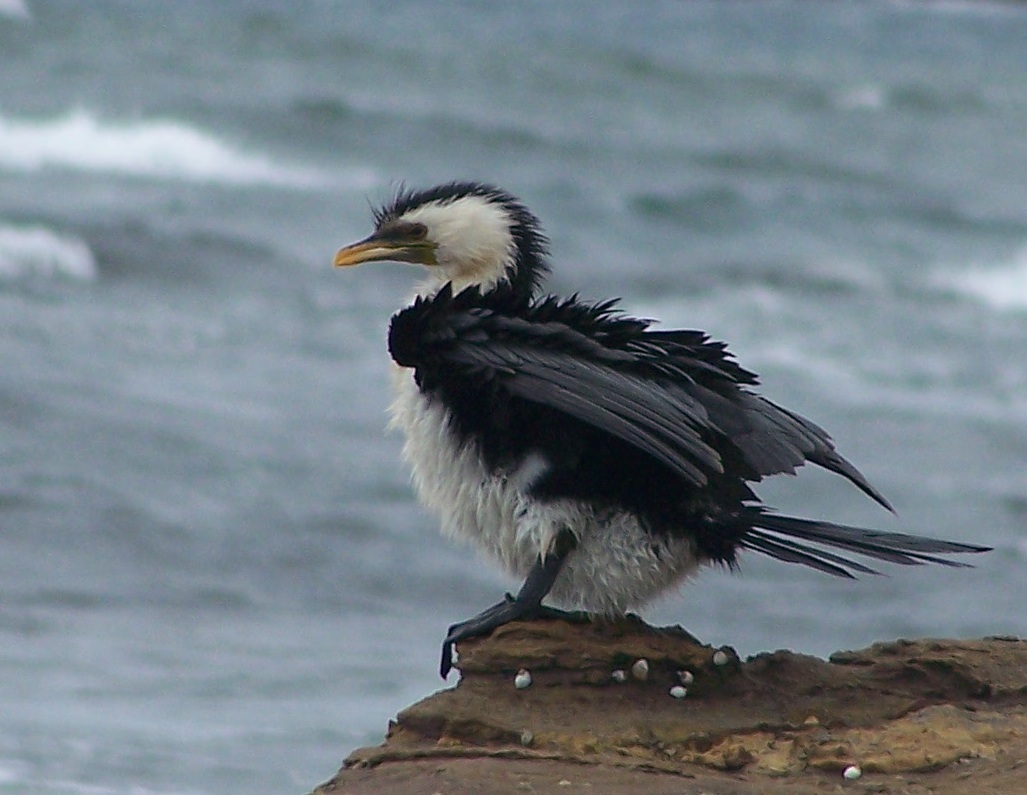
A little closer:


He took off shortly after posing for us and went diving for fish.

Christine went for a stroll to show off her lustrous shoulders:


She beckons to me:


She has found something:


It's a Cat's Eye shell (not Tiger's Eye, as is mentioned). We left it there in its little pool, because we thought it was a living snail. When we got home we found out it's actually an operculum, or "doorway," of a snail:

The operculum is attached to the upper surface of the foot and in its most complete state, it serves as a sort of "trapdoor" to close the aperture of the shell when the soft parts of the animal are retracted.
Ones like this are usually, my research says, from the Turbo genus of sea snails.

We went back to the pools to get it. Luckily it was still there.

It's a little hard to see, but it has some beautiful, subtle coloring. (Click on photo to em-biggen.)

 
Copyright © littleaustralia-Cinema-Blend Blogger Theme by BloggerThemes & newwpthemes Sponsored by Internet Entrepreneur